


Calm Down Corner Printables Kit: 20 Dyslexia-Friendly Pages for Kids
€17.00
A complete print-and-use calming corner kit to help deal with big emotions. Designed to work for children who don’t yet read English fluently, children with dyslexia, and children who need visuals. 20 pages covering breathing, body awareness, feelings, calming strategies, and reflection. A4 and US Letter both included.
Description
We have all experienced big emotions, and kids need help regulating them. This calm down corner printables kit does exactly that. It is built for easy independent use, so you can direct your energy where it’s needed while your kid learns to build confidence through agency.
Calm down corner printables built for the children often overlooked
In my experience teaching in international schools, working with multilingual learners, and supporting children with dyslexia, I often struggled finding accessible resources. Most calm down corner printables assume every child reads fluently in the language on the poster. Yours probably don’t.
This 20-page calming corner kit was built for those children (and makes it more clear for anyone, really).
Every page uses visual-first design: the images help convey the meaning. This makes it much easier to know what to do after you have modeled it. So, a child who doesn’t speak English or has trouble reading can still follow a breathing card, use the feelings chart, draw what they feel, etc.
Warm, low-glare backgrounds aligned with British Dyslexia Association guidelines. Dyslexia-friendly rounded fonts throughout and 2.0 spacing.
And rather than asking children to jump straight to naming their feelings (which is hard for anyone experiencing big emotions), this calm down corner printables kit starts with the body. Because you can’t regulate what you can’t first feel.
That body-based approach, grounded in embodiment and interoception research, is what makes these calm down corner printables work effectively and build lasting, foundational skills.
What makes this calming corner kit different from generic options
Most calm corner resources are designed for English-speaking, typically developing children in standard classrooms. This kit was designed for classrooms that reflect the globalized world. With children still learning the language and children whose brains process text differently.
Visual-first, language-light design
Every concept is communicated through image and icon first, with minimal supporting text. A non-English-speaking child can use every page in this kit independently (modeling helps of course).
Dyslexia-friendly throughout
Rounded fonts, warm cream and yellow backgrounds proven to reduce visual stress, generous white space, and short chunked text. Aligned with British Dyslexia Association design guidelines.
Body-based emotional regulation
Most emotional regulation tools start with feelings. This kit starts with the body, because that’s where feelings live.
Interoception (the ability to sense your own internal body signals, like a tight chest, a fluttery stomach, or tension in the shoulders) is the neurological starting point for all emotional awareness.
Before a child can name a feeling, they need to be able to notice it in their body. Before they can manage it, they need to feel safe having it. Research consistently shows that children who develop strong interoceptive awareness regulate emotions more reliably, build stronger social connections, and develop a more secure sense of who they are.
This isn’t just a calming strategy. Checking in with the body regularly — in safe, supported, curious ways — teaches children that their internal experience is worth paying attention to. That it makes sense. That it can be trusted. Building that habit over time creates the foundation of emotional regulation, healthy attachment, and feeling genuinely at home in yourself.
This body-first approach is grounded in a substantial body of research and clinical practice. Including the work of Bessel van der Kolk, Gabor Maté, and Peter Levine. Whose work across trauma, neuroscience, and somatic therapy consistently points to the body being the absolute foundation of emotional health.
A 3-step emotional regulation sequence built in
Many calming corner kits are a collection of individual tools. This one follows a deliberate sequence:
- identify the feeling
- rate how big it is
- choose the right strategy for that size of feeling.
Every page has a specific job in that sequence. And Page 17 — the child’s personal calm-down plan — brings all three steps together. These three steps ensure that children aren’t just using tools in the moment; they’re building effective self-regulation skills over time.
It’s a complete system Breathing cards, body awareness tools, feelings charts, calming strategies, a child-led plan, reflection pages, and more. All making one coherent kit. No one has the time to be sourcing and matching pieces from ten different places!
What’s inside this calm corner printables bundle: 20 pages
The 20-page calm down corner kit can be sorted into 5 categories. That might make it easier to decide how you want to use it.
4 breathing exercise cards
- Box breathing,
- Belly breathing,
- Star breathing,
- and 4-7-8 breathing.
Each with clear visual support so children can follow the steps without needing to read. Designed for children who process visually, including ESL learners and children with dyslexia. Simple, visual breathing exercises kids can use independently.
4 pages to set up the corner
- A calm corner poster, or calming corner sign.
- A step-by-step adult setup guide.
- An “I need a break” request card (4 per page, print and cut). Children show the card to ask for the corner instead of disrupting the class, which builds self-advocacy alongside regulation.
- A co-regulation script card with suggestions of exactly what to say at each step of the calm down process (from when big emotions come up until after the use of the calming corner), so you don’t have to find the right words on the spot.
Often, calming corner kits focus entirely on the child and leave the adult to manage the moment alone; this one aims to support both.
6 body awareness and feelings pages
- A body check-in poster that helps children notice and name physical sensations.
- A feelings and body sensations chart. Linking emotion words to where they’re felt in the body. Based on Nummenmaa’s cross-cultural body mapping research showing consistent patterns across cultures in how emotions are experienced physically.
- A “draw how you feel” body outline page. Rooted in art therapy and expressive arts research showing that putting feeling onto the page through colour and mark-making helps process and release it. The body is involved in the drawing, so the emotion moves through rather than staying stuck.
- Feelings charts for ages 4–7, with vocabulary matched to the age range.
- Feelings charts for ages 8–12, with vocabulary matched to the age range.
- A 1–5 intensity scale using animals. From a small ladybug (or ladybird) to a large elephant, alongside color and number. Animals give children a universally understood, language-free visual for emotional size, aligned with the Incredible 5-Point Scale framework. Specifically designed for multilingual learners, and for autistic children and young children who find subtle facial expression scales unreliable.
4 calming strategy pages
- A coping strategies choice board so children pick their own tool based on the emotion intensity, rather than being told what to do. Builds confidence and agency.
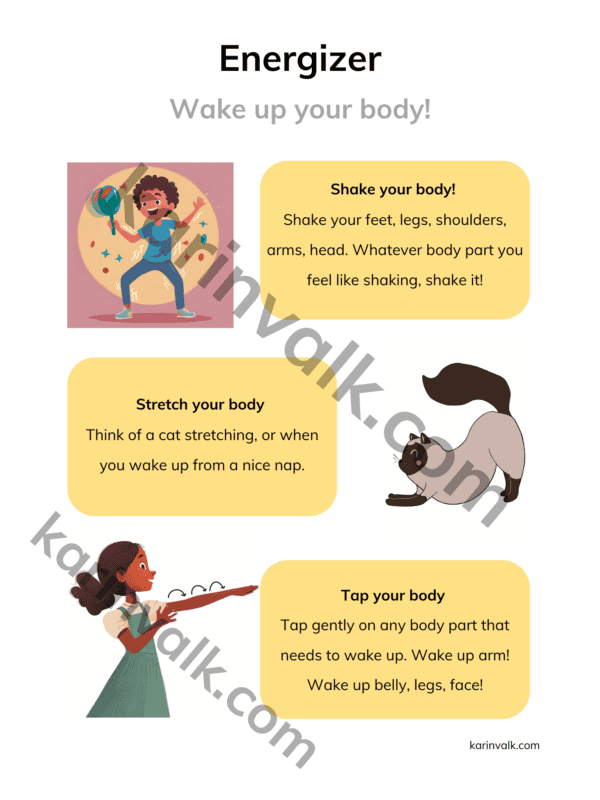
- A movement strategies card with body-based tools including rhythmic movement and grounding.
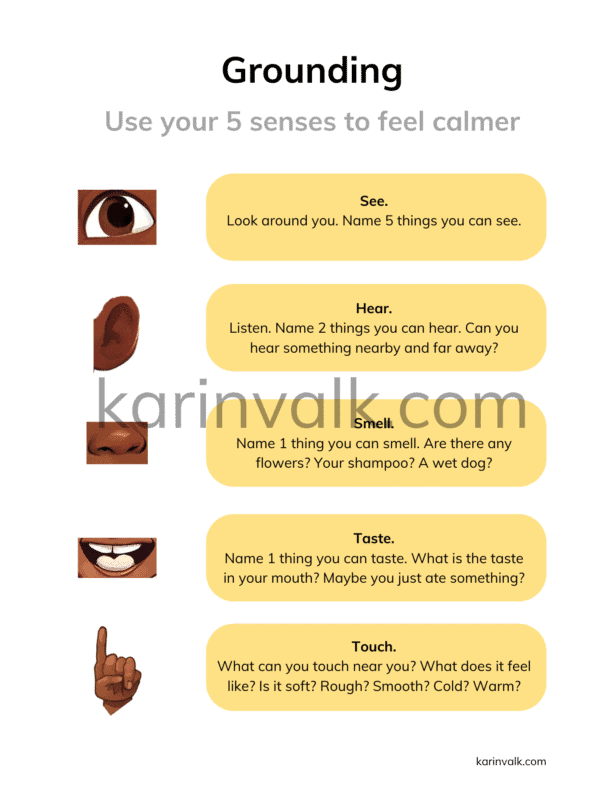
- A 5-4-3-2-1 grounding card with visual image references for each sense.
- A personal calm-down plan children fill in themselves (or with an adult). It helps connect feeling to intensity to strategy, building real self-regulation skills over time.
2 activity pages
- A calm coloring page for focused, quiet activity.
- A repeatable “I feel better when…” reflection page that helps children notice what works for their own body, and builds the habit of checking in.
Who this calming corner printables kit is for
International school and bilingual classroom teachers who need materials that work for children at different levels of English proficiency, without two or more versions of every poster.
Teachers and learning support staff supporting children with dyslexia, sensory sensitivities, or autism, who need visual supports designed with those children in mind.
Parents setting up a calm corner at home. Especially parents of children who deal with big feelings and emotions.
School counsellors and occupational therapists looking for a body-based regulation toolkit that goes beyond generic coping skills posters and supports children in building real awareness over time.
Anyone wanting to create an effective calming corner for kids.
How to use it
Once purchased, you will receive an email with the download links to both files (sizes A4 and US Letter are both included in one purchase). Print the pages relevant to your space and laminate the breathing cards and “I need a break” cards for durability.
Set up the corner using the adult guide and look through the script card for suggestions so you are prepared in moments of higher intensity. Introduce the calm corner to your children by modeling the use of cards and the space. They likely need a few practice rounds to get to know the cards if they can’t read the instructions.
Help each child personalize their own calm-down plan.
The whole calm corner can be up and running in an afternoon.
Details
- 20 unique printable pages
- A4 and US Letter. Both formats are included in one download
- Find the email with instant PDF download — no waiting, no shipping
- Designed for colour printing on a standard home or school printer
- Dyslexia-friendly fonts and warm low-glare backgrounds throughout
- Age-appropriate pages labelled for 4–7 and 8–12 where relevant
- For home and classroom use
- Created by an embodiment coach and former international school teacher
Questions people ask about this calm down corner printables kit
Are these calm down corner printables suitable for children who don’t speak English? Yes. This is one of the things that makes this kit different. Every page is designed so that visuals support understanding. A child who doesn’t yet read English can follow the breathing cards, use the feelings chart, and work through the body check-in poster without needing to understand the text. All pages, once modeled, should be accessible to kids with a different home language.
Are these printables dyslexia-friendly? Yes. All pages use rounded dyslexia-friendly fonts, warm low-glare background colours recommended by the British Dyslexia Association, generous white space (2.0 spacing), and short chunked text. There are no dense paragraphs and no serif fonts anywhere in the kit.
What age range are these calming corner printables designed for? The kit covers ages 4–12. Pages that work differently for younger and older children — the feelings charts and the intensity scale — are labelled by age range so you can use the right version for your group.
Does this kit teach children how to regulate emotions, or just give them tools to use? Both. Each page has a specific role in a 3-step sequence: identify the feeling, rate how big it is, choose the right strategy for that size. The personal calm-down plan on Page 17 brings all three steps together so children aren’t just reaching for a random tool when they’re overwhelmed. They’re following a process they’ve practised and made their own. It also includes a reflection page to help notice what works for them personally. Over time, that process becomes an internal skill they take with them for the rest of their lives.
What’s the difference between a calming corner kit and a calm down corner kit? Nothing, they’re the same thing. “Calming corner”, “calm corner”, “calm down corner”, and “cool down corner” are all names for the same dedicated space where children go to regulate their emotions. This kit works for all of them.
What is a calm down corner?
A calm down corner (also called a calming corner, cool down corner, or calm corner) is a dedicated space in a classroom or home where children can go when their emotions feel big. It’s stocked with tools such as breathing cards, feelings charts, calming strategies, and comfortable objects like stuffed animals or soft pillows. Ideally, they help children regulate independently. We’re not sending children away; we’re giving them a safe, supported place to notice what they’re feeling and find their way back to calm.
What should be in a calming corner for kids?
A well-stocked calming corner typically includes breathing exercise cards with visual guides, a feelings chart children can point to, a body check-in tool, coping strategies children can choose from themselves, and a way to signal they need a break. This kit includes all of those, plus a co-regulation script card for the adult, because saying the right thing can make a big difference.
Do I need to buy separate versions for A4 and US Letter paper? No. Both A4 and US Letter formats are included in one download. You get two PDFs, one for each paper size. So, whether you’re printing in Europe, the US, or anywhere else, you’re covered.


Reviews
There are no reviews yet.