If you’ve ever wondered what anger issues are — or suspected you might have them — you’re in good company. Anger issues are one of the most misunderstood emotional patterns there are, partly because anger itself is so often treated as the problem. This post is about understanding what’s really going on: the signs, the causes, and what your anger might be trying to tell you.
I earn commissions when you shop through the links below at no additional cost to you. As an Amazon Associate I earn from qualifying purchases.
I sometimes include Amazon links because I know ease and accessibility matter—especially for busy parents and teachers—but I’m also working on adding more options from smaller or values-aligned businesses. I’ll keep updating this post as those become available.
There is a big difference between managing anger in a way that says “you’re inconvenient” and understanding it. The former drains a lot of energy and often repeats the cycle. The latter changes your relationship with it entirely.
As a teacher and embodiment coach, I’ve seen what a difference it makes when people start to understand their anger instead of trying to control it. That truly creates a positive ripple effect through all areas in life.
In this post, I’ll break down what anger issues are, how to recognize the signs of anger issues in yourself or someone you support, and what causes anger issues. You’ll also find out what anger issues look like under the surface, what is behind anger, and what your anger might be trying to tell you.
This post is all about answering the question “what are anger issues”.
If you’re looking for practical steps to deal with anger then you might find this post very helpful:
Related post: How to Control Anger Issues in 7 Easy Steps
What Are Anger Issues?
So, what are anger issues? Anger is a normal emotion. Most people feel it at some point. Some feel it intensely and often. Others find they can barely reach it at all. And anything in between.
Anger issues is the term used when anger consistently gets in the way. Whether it’s its frequency, intensity, the way it gets expressed, or the way it gets suppressed causing it to come out as physical ailments.
It’s not just one moment of snapping at someone when you’re exhausted. Anger issues is a recurring pattern that affects your relationships, your wellbeing, your ability to function in daily life, and much more.
That pattern, however, can look very different from person to person. Let’s get into it.

When Does Anger Become Anger Issues?
One outburst doesn’t make anger issues. Neither does being short-tempered when you’re overloaded or haven’t slept. Anger becomes anger issues when the pattern is consistent enough to cause real problems. That can be at home, at work, in the classroom, inside you, wherever.
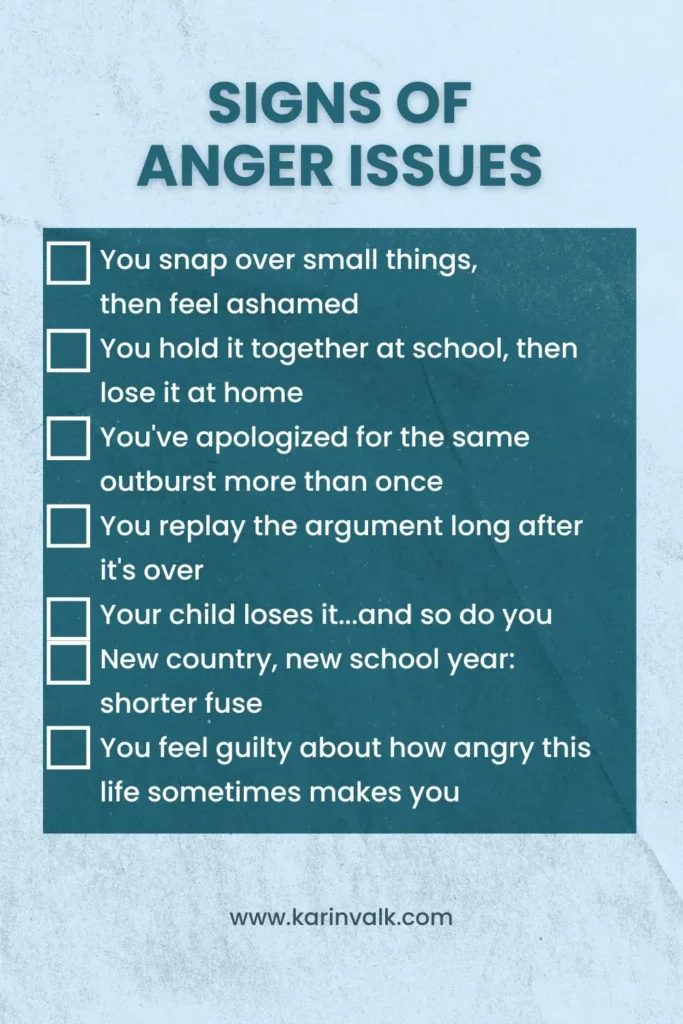
Some signs that it’s crossed the line from anger to anger issues:
- anger comes up faster or more intensely than the situation seems to call for;
- it’s hard to de-escalate once it starts;
- you feel confused or ashamed about it afterwards;
- or people around you have started walking on eggshells.
It’s also worth knowing that anger issues don’t always look “loud”. Suppressed anger — held back, never expressed, turned inward — is just as much a pattern worth paying attention to. Maybe even more so. More on that later in this post.
What Do Anger Issues Look Like?
Anger issues look different depending on the person. Some people explode and then feel terrible. Others go cold and distant. Some keep it all inside and feel it only in the body (a tight chest, a clenched jaw or fists, a constant low-level muscle tension, a frown that seems to never leave).
In an international school environment, anger issues in children can look like a child who refuses to engage, reacts strongly to small corrections, or seems to have lost patience they used to have.
For adults navigating constant change (new countries, new colleagues, new language, ongoing uncertainty, people leaving around them) anger issues can show up as irritability that feels out of proportion, or a sense of always being on edge, maybe even without a clear reason why.
What anger issues look like is personal. What matters is the pattern, not the single moment. We all have moments. Context is everything.

Anger Issues Signs and Symptoms
Recognizing the signs of anger issues is not always straightforward. Anger doesn’t always look obvious, and anger issues symptoms can show up very differently depending on the person.
Sometimes it’s not outward and only visible in the body. Sometimes in patterns of behavior. Yet other times it’s noticeable slowly over time in how your relationships feel.
The sections below break each one down.
Physical Signs of Anger
One of the clearest anger issues signs is what happens in the body. If you’ve practiced noticing and creating awareness of what you do in your body (which actually not that many of us have), this is a great way to learn to recognize anger early. It often shows up in the body before you’ve even registered what you’re feeling.
Physical signs of anger can include:
- heat rising in the face or chest;
- the jaw or shoulders tightening;
- breath becoming shorter and higher up in the chest;
- and a sudden surge of energy that seems to want to move somewhere or do something.
For some people, the physical signs of anger are obvious and hard to miss. For others, they’re subtle enough to write off as stress or tiredness — until the pattern becomes clearer over time.
Paying attention to what anger feels like in the body is one of the most useful things you can do. Not to stop it. Just to notice it earlier. Creating awareness, then choice.
Anger Issues Symptoms: Behavior and Reactions
If you’re wondering how to tell if someone has anger issues, then you might be dealing with someone who expresses anger more inwardly. Behavioral signs of anger issues can look very different depending on how someone expresses — or doesn’t express — anger.
On the surface, anger issues might show up as snapping at people over small things, saying something sharp in the moment and regretting it immediately, reacting more strongly than you intended, or feeling angry and irritable for extended periods without being able to point to why.
But anger issues can also look like the opposite: shutting down completely, going cold, withdrawing from conversations, or avoiding certain situations because you don’t trust your own reaction.
It’s always a good idea to check in with yourself regularly throughout each day and notice how you feel and what you need. You’ll recognize patterns sooner, and you will be able to understand where your anger comes from with more clarity.
Signs You Have Anger Issues in Relationships
Anger issues in relationships often show up slowly, which is part of why they can be easy to miss at first.
Eventually, you might notice that conversations regularly escalate into arguments, that people close to you seem cautious about what they say, that there’s a growing distance you can’t quite put your finger on (stopping myself from making a dad joke about the tangibility of distance), or that you feel misunderstood more often than you’d expect.
From the other side: if you’re a parent, teacher, or partner of someone with anger issues, you might notice you’ve started choosing words carefully, avoiding certain topics, adjusting your own behavior to prevent a reaction, or feeling responsible for keeping the peace.
All of these patterns are worth paying attention to. There are solutions, and we have to start with awareness.
If you’re noticing these signs in your child, these 11 games for emotional regulation are a practical way to help them build anger and coping skills in a fun way:
What Causes Anger Issues?
Anger issues don’t appear out of nowhere. There is almost always something underneath: a combination of what’s happening in the body, what has been building up over time, and what a person learned (or never learned) to do with the feeling.
What causes anger issues is rarely one single thing. The sections below look at two of the most important pieces: what triggers anger outbursts in the moment, and the deeper root cause of anger that often goes unaddressed.
What Causes Anger Outbursts?
Anger outbursts are rarely just about the moment that triggered them. Especially when the feeling is as strong as an outburst, it’s most likely the result of some sort of build up.
Imagine a glass of water. If the glass is already full, even a drop causes it to overflow. The drop isn’t the problem. The fullness is.
What fills the glass over time varies from person to person:
- ongoing stress,
- poor sleep,
- feeling out of control in your environment,
- unprocessed emotions from earlier in the day/week/year/entire lifetime.
For many people in international school communities, there is also the constant background pressure of navigating a world that isn’t quite familiar yet: a new language, unfamiliar social rules, repeated goodbyes, and a sense of never fully landing or belonging. These things really do add up.
When the nervous system is already working hard just to keep up, the threshold for anger outbursts drops significantly. It’s important to remember that that has nothing to do with character or you as a person. Anybody going through this will have strong emotions to deal with.
If you struggle with finding a sense of belonging and feel that might be part of your root cause of anger, this post might be very helpful:
Related post: 9 Ways to Create a Sense of Belonging Anywhere
The Root Cause of Anger

If anger outbursts are the overflow, the root cause of anger is usually what’s been filling the glass for a long time.
At its core, anger tends to show up around three things:
- feeling that something is unfair,
- feeling that a boundary has been crossed,
- feeling powerless to change something that matters.
Knowing this, hopefully you can tell that feeling anger is not a weakness. The body and mind are registering that something is off. It’s an important signal, so instead of suppressing it, let’s listen to what it has to say.
For children and adults in international school environments, number 3 is particularly relevant. When you have no say in where you live, who you say goodbye to, or what school you attend, powerlessness can be a big factor. It is present daily, whether in the background or foreground. Anger — even when it looks like defiance, irritability, shutting down, or anything else — is often the most honest response available. Again, let’s listen to it.
Anger in Chinese Medicine
In Chinese medicine, the connection between unexpressed anger and the body has been understood for centuries. The liver is seen as the organ most closely linked to anger. Its job, in Chinese medicine terms, is to keep your energy moving smoothly through your body. When it can do that, you feel like yourself.
But when anger keeps getting pushed down, held in, never expressed, that energy gets stuck. Chinese medicine calls this “liver qi stagnation”. Imagine it as a river that suddenly has nowhere to flow. The water doesn’t disappear (like the emotion doesn’t). It backs up.
In the body, that backup can show up as tension in the chest or ribcage, headaches, tight shoulders, difficulty sleeping, or an irritability that sits just under the surface constantly. Over time, the stuck energy looks for other ways out: sometimes as sudden outbursts, sometimes as physical symptoms that seem completely unrelated to emotion.
Different language from Western psychology, same basic observation: when something is held in and not expressed, it doesn’t just disappear, but it builds. And eventually, it goes somewhere.
Is Anger Bad? Why Judging It Makes Things Worse
Ask most people what they think of anger and you’ll get some version of the same answer: it’s bad. Something to control, avoid, apologize for, be ashamed of, you name it. And that judgment, the idea that anger itself is the problem, is one of the main reasons anger issues become so hard to work through.
Because judging a feeling doesn’t make it go away. Instead, it gives you two problems instead of one.
Here’s why: when you decide a feeling is wrong or bad, you start fighting it. And fighting an internal state is a bit like trying not to think about a pink elephant (especially us visual learners will immediately picture it!). The more you push against it, the more present it becomes.
Research on emotion regulation backs this up: suppressing or resisting an emotion tends to increase its intensity instead of reducing it.
Acceptance is where we start! Not acceptance in the sense of “I’m fine with this” or “this is okay”. More like: I can feel this without making it mean something is wrong with me. This might seem small, but it’s actually a huge change; going from fighting to acknowledging it.
This change is often what allows the feeling to “move”. Because emotions are designed to move through us, not stay and build up. What keeps them stuck is the resistance.
So the purpose of anger is not to eliminate it. It’s there for a reason, so the first step is to stop adding the layer of shame or judgment on top. Because that layer is often what makes everything so much harder.
What Is Anger Issues a Symptom Of?

Anger is a symptom of something, almost always. It rarely shows up for no reason (dare I say never?).
As I said before, most often, anger is a symptom of feeling that something is unfair, that a boundary has been crossed, that you are not being heard, or that you have lost control over something that matters to you.
But what I almost never hear people speak of is that anger can also be a symptom of coming back to life. When someone has been feeling completely flat, hopeless, depressed, or powerless for a long time, anger can be a feeling of such relief.
It might not look or feel good to people around that person since society doesn’t generally appreciate anger. But suppressing it or judging it will cause them to go back to the more negative feelings mentioned before. The trick is not to stay in that anger for months, but move to better feeling emotions bit by bit.
That is not always an easy thing to do as the person experiencing the anger, or as the person being around it, but that is how to best support ourselves or the people around us.
What Is Your Anger Trying to Tell You?
Anger is not random. It shows up for a reason, and learning to read what it is telling you is one of the most useful things you can do with it.
The sections below look at two sides of this: what anger is pointing to underneath, and what is genuinely helpful about it. Even when it feels like the last thing you would call useful.
What Is Helpful About My Anger?
More than most people expect.
Anger tells you that something matters to you. That is useful information. When anger is building up, it is often pointing directly at something you value: fairness, respect, safety, being seen, etc., that feels under threat or missing.
Anger also gives you energy. Unlike sadness or hopelessness, which tend to pull you inward and downward, anger moves you toward something. That energy, the drive to speak up, change something, push back, or refuse to stay stuck, is not the problem. It is only the signal. What you do with it is the question.
And for anyone who has ever felt completely flat or beaten down, anger can be a sign that something in you is waking up again. That a part of you still cares and is ready to do something about it. Sounds genuinely useful to me!
What Is Behind Anger?

Anger is often called a secondary emotion, meaning it usually has something behind it. Underneath most anger, you will find one or more of these: fear, sadness, grief, shame, or powerlessness.
This doesn’t mean the anger isn’t real or worthy of attention. It absolutely is. But it helps to know that when someone — a child, a colleague, a loved one, yourself — is expressing anger, there is almost always something more vulnerable sitting underneath it that hasn’t been felt or expressed yet.
This is especially true in international school environments, where loss is constant but rarely named as such. A student losing their friend group for the third, fourth, millionth time. A teacher navigating a new culture alone. A parent watching their child struggle to belong. Family members having no choice in when or where to move. We can probably all think of situations like these.
The grief of those experiences often has nowhere to go. And anger, which feels stronger and safer than sadness, steps in.
Understanding what is behind anger helps to identify the needs that haven’t been met yet. And that’s a great place to start, after the acceptance we talked about before.
Holding Back Anger: What It Does to Your Body and Relationships
There’s a common belief that the solution to what are anger issues is learning to keep the lid on. To swallow the feeling, stay calm on the outside, and “just” move on. For a lot of people, especially those who grew up in environments where anger wasn’t welcome, holding back anger becomes the default.
The problem is, it doesn’t actually go anywhere. It stays in your body. It shows up in your health. And it tends to come out in unhelpful ways in the relationships you care most about.
Research into the effects of anger on health (including Gabor Maté’s work on how suppressed emotion contributes to physical illness, and Bessel van der Kolk’s research on how the body stores what the mind tries to ignore) paints a consistent picture: what doesn’t get expressed doesn’t go away. It just waits, and gets added to.
Below, we’ll look at where exactly it waits, and what that costs you.
Effects of Anger on Health: What Suppressed Anger Does to Your Body
The body doesn’t distinguish between anger that’s expressed and anger that’s pushed down. What it registers is activation: the same stress hormones, the same elevated heart rate, the same muscle tension, you name it. When that activation doesn’t get to complete itself through expression or movement, it tends to get stored. In the body.
Gabor Maté has documented extensively how suppressed emotions — anger in particular — are linked to chronic illness, autoimmune conditions, patterns of physical pain, and more. Bessel van der Kolk’s work shows the same thing from a different angle: the body keeps a record of what the nervous system was never allowed to process.
Unprocessed anger often shows up as chronic jaw tension, back and shoulder pain, recurring headaches, digestive issues, and even more serious illnesses or mental health issues. In Traditional Chinese Medicine, the liver is said to govern the free flow of emotions, and stagnant anger is seen as one of the root causes of liver qi imbalance…which tends to manifest in exactly these kinds of physical symptoms.
If your body has been carrying anger for a long time, it’s worth noticing where and how that might show up for you personally.
If you’re interested in reading more about this you can find Gabor Maté’s book “When the body says no” here on Amazon, or on Bookshop.org.
And Bessel van der Kolk’s book “The body keeps the score” is available here on Amazon, or on Bookshop.org.
What Holding Back Anger Does to Your Relationships
Holding back anger doesn’t usually protect the people around you. And over time, it finds other ways out.
You could become the person who says “I’m fine” and then creates distance or sabotages a relationship. Who explodes over something genuinely small (e.g the dishes, being five minutes late) and can’t explain why that particular thing tipped it. Who agrees to things and then doesn’t follow through. Who builds resentment. Whose partner, children, or colleagues learn to read the mood from how you put down a glass.
Children are especially sensitive to this. They pick up on tension in a room even when no words are spoken. And when they can’t identify the source, they often conclude it must be them. As adults, I hope we want to protect them from that and take responsibility for our own internal state.
The harder truth is that what looks like protecting your relationships by staying quiet often has the opposite effect. The people closest to you don’t feel your anger less. They just feel it without any context, which is harder to be close to than honesty would have been.
If you’re a parent and that landed close to home, my post on co-regulation strategies for parents walks you through how to reconnect with your child even when your own emotions feel intense.

Frequently Asked Questions About Anger Issues
Below are the questions about anger issues that come up most: around anger issues symptoms people recognise in themselves, why they feel angry all the time, and what different types of anger issues might look like.
Short answers here; the fuller picture is in the sections above.
Why Am I Angry All the Time?
If you feel angry all the time (or like it’s always just under the surface) it usually means your nervous system is running consistently close to its threshold. It’s basically constantly activated. Ongoing stress, poor sleep, chronic overwhelm, or a persistent sense of powerlessness can keep the whole system activated even when nothing dramatic is happening.
The feeling of being angry all the time is rarely about one thing. It’s more often about everything that’s been accumulating. So it doesn’t mean anything about you as a person or your character. It’s just information that your body is under sustained pressure. Be kind to yourself.
What Are the Different Types of Anger Issues?
Types of anger issues vary more than most people might expect. It could look like explosive outbursts, often sudden, intense, and out of proportion to what triggered them.
Others are more subtle patterns like chronic irritability or passive aggression.
Some people experience what are anger issues as mostly physical: jaw pain, stiff shoulders, neck and back muscles, frequent stomachaches or even more serious illnesses. Western medicine does not regularly (yet) connect physical symptoms to emotion.
Yet other people swing between shutdown and explosion, with very little in between. What the types tend to share is that the anger isn’t moving through freely. It’s stuck.
Are Anger Problems and Anger Issues the Same Thing?
Largely, yes. What are anger problems and what are anger issues describe the same territory: a pattern where anger shows up in ways that affect your wellbeing, relationships, work or school situations, you name it.
If you’ve been searching for anger problems and landed here, you’re in the right place. What causes anger problems is the same ground we’ve covered in this post: nervous system activation, unprocessed emotion, circumstances that make it difficult for anger to complete its natural cycle, and the consequences of this happening.
Is Anger a Mental Health Issue?
Anger itself isn’t a diagnosis, it’s a natural human emotion. But persistent or unmanageable anger can be a symptom of underlying mental health challenges including anxiety, depression, PTSD, or burnout.
It can also simply be a signal that something in your current circumstances — your stress load, your environment, your unmet needs, boundaries being crossed, etc. — genuinely needs to change.
Treating anger as a mental health problem to be fixed often misses the point. Understanding what it’s pointing to tends to be considerably more useful.
Where Do Anger Issues Come From?
Where do anger issues come from is one of the most important questions you can ask, because many people spend a lot of energy managing anger without ever asking that.
The short answer: a combination of patterns learned early about whether anger was safe to express, and circumstances that create ongoing feelings of powerlessness or not being heard.
What are anger issues at their root? Usually a very human response to a situation that has felt unmanageable for a long time.
How Do I Start Processing Anger?
Processing anger starts with getting curious about it rather than trying to eliminate it. What is it pointing to? What does it feel like in your body? (the more you learn to recognize this, the earlier you’ll pick up on more subtle signs) What need underneath it hasn’t been met?
If you’re looking for practical steps to start processing anger then you might find this post very helpful. Understanding your anger and knowing what to do with it in the moment are two different skills. They are both important, and one makes the other considerably easier.