What is belonging, really? Most people start asking that question because something inside them feels uncertain or unseen. This post explores what belonging actually means, how it feels in the body and in real life, and why understanding it can change the way you relate to yourself and others.
Many people wonder “what is belonging?” because they’ve never been fully sure they’ve felt it. They may have communities or familiar places around them, yet still question what does belonging mean, and what it’s supposed to feel like. And why it seems to come more easily to others.
This uncertainty is especially common for people with globally mobile lives, but it’s not limited to them. Belonging can feel elusive even when everything looks great on the outside.
In this post, we’ll explore what is belonging, what does belonging mean in real life, what is belongingness, belonging quotes, and more!
Drawing on research, lived experience, and insights that shape my coaching work around belonging, this post will help you understand what belonging actually is. It also covers how belonging differs from fitting in, and how to recognize the feeling of belonging—or the feeling of not belonging—when it shows up in your life.
This post is all about the question: what is belonging?

What Is Belonging?
So, what is belonging?
When people search for what is belonging or try to understand the belonging meaning, they’re rarely looking for a textbook definition. They’re trying to name an experience that is hard to describe. If we try to define belonging in simple terms, then belonging is the felt experience of being able to authentically be yourself while staying in connection with others.
The meaning of belonging goes beyond being included or welcomed on the surface. You can be part of a group and still wonder “what does belonging mean?”, because belonging isn’t just about being present somewhere. It’s about how natural and safe it feels to be there.
Belonging Is More Than Being Included
This is where many people get confused about what does it mean to belong. Belonging isn’t something you earn by behaving well or proving your value (spoiler alert: you’re inherently valuable!). It’s the internal sense that you don’t have to perform or shrink in order to stay connected.
You can be included in a community or group, but if you’re putting on a mask to make that happen, then you don’t truly belong. And you deserve to belong.
For some, belonging becomes most visible through contrast. You might recognize moments where everything looks right on the outside (like you’re included), yet something inside feels off. That experience often leads people to question the belonging meaning itself, or to wonder whether they’ve ever truly felt it.
Understanding what is belonging starts here: do you feel that you’re allowed to exist as you are, without having to edit yourself to be part of something?

What Does Belonging Mean in Real Life?
So, what does belonging mean when it’s not just a concept?
In everyday life, belonging is usually subtle. It can be as simple as walking into a room and not immediately wondering how to act. Or texting someone and not rehearsing the message three times first. If you’ve ever wondered what does it mean to belong, it often comes down to this: you feel like you can relax into being yourself, without losing connection with others.
Sense of Belonging Examples in real life
Here are a few sense of belonging examples that might resonate:
- You’re with someone and you don’t feel the need to “perform” your personality.
- You can disagree without fear that you’ll be punished or excluded.
- You can be quiet without feeling like you have to earn your place with energy or jokes.
- You feel wanted, not just tolerated.
- You don’t have to explain your background, your accent, your family, or your choices just to be understood.
For people living internationally, these sense of belonging examples can become extra noticeable. You may find yourself asking questions like: Why do I feel like an outsider even when everyone is friendly? Why do I miss a place even when I chose to leave? Why do I feel “at home” in a café in a new city, but not in a community I’ve known for years?
This is very common. As humans, we are wired to belong. And it’s just not as simple as we would often like it to be. Be kind to yourself, you’re not doing anything wrong.
If you’re raising or working with children who move between cultures, this post on supporting third culture kids explores how belonging can feel complex when home isn’t tied to one place.

What Is Belongingness?
So, what is belongingness, and why does this word even exist?
Belongingness is the psychological term used to describe our innate human need to belong. When people search for what is belongingness, they’re often trying to understand whether belonging is just a feeling or something more fundamental.
In psychology, belongingness refers to the basic need for connection, acceptance, and meaningful social bonds. It’s part of being human.
While belonging is the felt experience of connection, belongingness describes the underlying need that drives us to seek it. This is why people can feel unsettled or disconnected even when their lives look full on the outside. When the sense of belongingness isn’t met, the nervous system stays on alert, always scanning for safety or reassurance.
Belongingness Is a Need, Not a Weakness
It’s important to say this plainly: needing belonging does NOT make you needy. Research consistently shows that belongingness is as essential to our well-being as feeling safe or loved. When that need goes unmet for long periods of time, people often experience self-doubt, low self-esteem, the persistent feeling that something is missing, or even mental health issues like depression.
Basic needs are basic for a reason – they form the basis, the foundation, of a healthy life.
Understanding what is belongingness helps explain why belonging can feel so elusive. You’re not imagining it, and you’re not failing at something others have mastered. You’re responding to a real human need that wants to be met.
This also helps clarify why belonging can’t be forced through fitting in. A true sense of belongingness isn’t created by changing yourself to be accepted. It’s an innate need, meaning it comes from within. So, only being your authentic self (who you truly feel to be on the inside) and being seen, heard and loved as that person, can create that profound feeling of belonging.
And yes, that is some scary sh*t. But worth it.
Belongingness in Psychology
If you’re still wondering what is belongingness, psychology gives us language for something many people already know in their bones: humans don’t just like connection, we need it.
In research, belongingness describes the basic drive for meaningful bonds and acceptance. That’s why a lack of belonging doesn’t just feel sad. It can feel disorienting. When the sense of belongingness isn’t met, many people don’t think, “I need belonging”. They think:“What’s wrong with me?” or, “Why can’t I just be normal and feel comfortable here?”.
Thinking it’s a reflection of who we are is common. It’s important to know though, that there is nothing wrong with you. As explained before, we need belonging, and if it was such an easy thing to experience then it wouldn’t be such a big deal for so many of us.
Where Belonging Fits in Maslow’s Needs
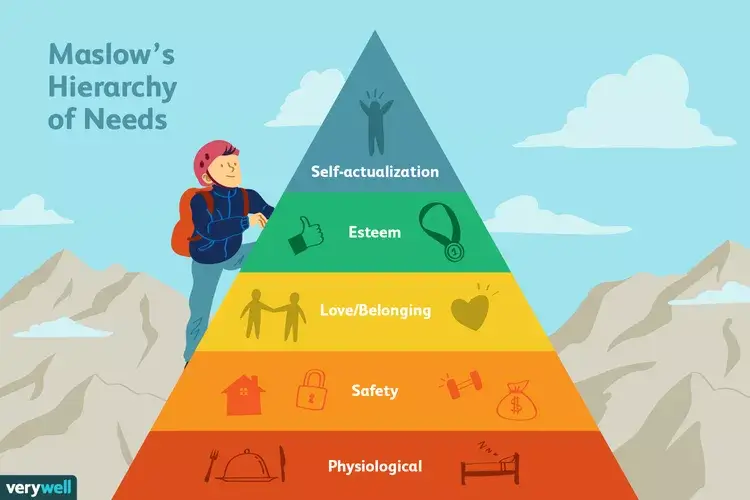
In Maslow’s framework, belonging sits alongside love as a core human need. So it’s not a luxury. And that matters, because it supports the point I already made: belongingness is a need, not a weakness. Wanting to belong is part of the design.
This also links back to your lived experience. If you’ve ever felt like you’re “fine” on paper but still not peaceful inside, it is not because you’re ungrateful or broken. It may simply be that your system is still looking for genuine connection and the kind of acceptance that doesn’t require self-editing.
What Is a Sense of Belonging?
When people talk about a sense of belonging, they’re usually pointing to the moment-to-moment awareness of belonging. It’s not a different kind of belonging, and it’s not something separate from the experience itself. Rather, a sense of belonging describes how clearly you can feel and recognize belonging as it’s happening.
This is why people often search for what is a sense of belonging or sense of belonging meaning. They’re not asking for another definition. They’re trying to understand why belonging can feel present one moment and absent the next, or why it feels strong in some places and relationships but faint or confusing in others. A sense of belonging meaning lives in awareness, in everyday moments.
A Sense of Belonging Is the feeling of belonging in our body
Just like any other emotion or feeling, a sense of belonging shows up in the body. It might feel like ease, a softness. You may notice it when conversation flows without effort, when you’re not monitoring how you come across. Maybe you feel that you’re allowed to take up space just as you are.
Because a sense of belonging is tied to awareness, it can change from moment to moment. You might feel it strongly in one environment and barely at all in another. For people who have moved often or lived across cultures, this awareness can be especially subtle. Familiarity doesn’t always translate into comfort, and belonging may no longer be linked to places or roles that once felt obvious.
At the same time, this experience isn’t limited to globally mobile lives. Many people question a sense of belonging meaning even in long-standing communities or relationships.
Understanding what is a sense of belonging helps explain why belonging can feel elusive. It’s not that belonging isn’t there at all. Often, it’s that your awareness is picking up on whether a particular space, relationship, or situation truly allows you to be yourself in that moment.
What Does Belonging Feel Like?
So, what does belonging feel like when it’s actually there?
For many people, the belonging feeling isn’t loud or dramatic (unless you felt a clear sense of not belonging and suddenly something made you feel belonging…that can be pretty loud, and awesome). Generally though, it’s subtle and “just there”.
You might notice a sense of ease, as if you don’t have to hold so much tension in your body. There’s less second-guessing, less effort spent on managing how you come across.
The feeling of belonging often looks like inner permission. You feel allowed to be yourself without constantly adjusting or proving your place. Conversation flows more naturally, silence feels less awkward, and you’re not bracing for rejection in the background.
Because belonging can be hard to put into words, many people recognize it most clearly through resonance — when someone else describes it, and something inside you feels, yes, that’s it.
Hopefully the following belonging quotes can help.
Belonging Quotes That Put Words to the Feeling
Sometimes the clearest way to understand belonging is through recognition. When someone else names an experience you’ve felt but never quite articulated. These belonging quotes and sense of belonging quotes add depth and nuance to what belonging feels like, especially when it’s been elusive.
I don’t know about you, but these quotes about belonging sure stir things up within me.
One of the most widely shared Brené Brown quotes captures the heart of belonging in a single line. As Brené Brown writes:
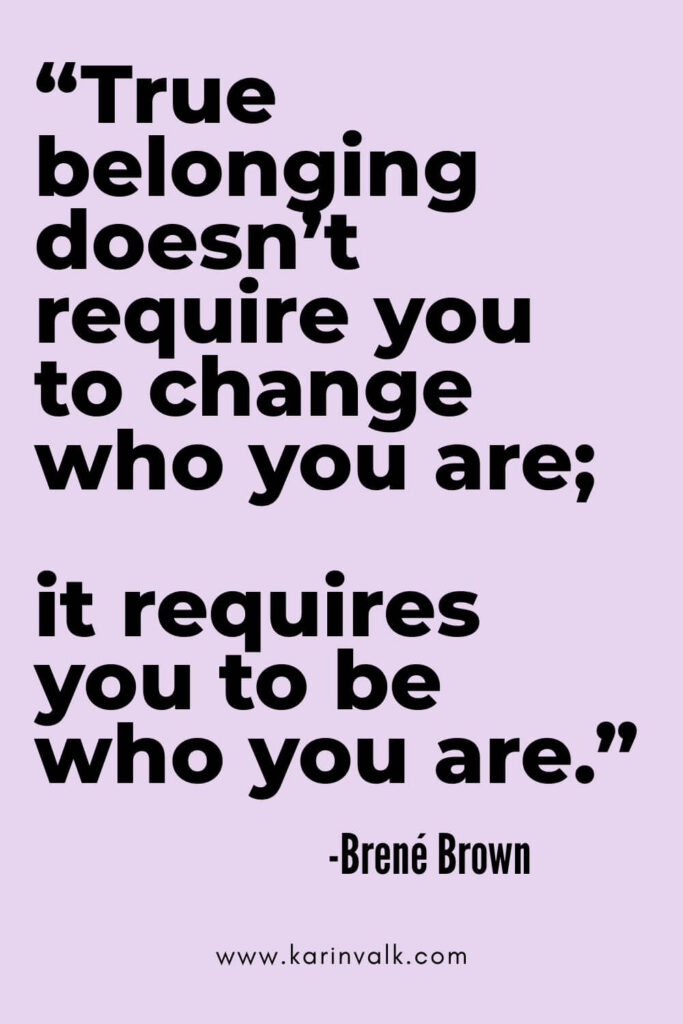
“True belonging doesn’t require you to change who you are; it requires you to be who you are.”
She also names the inner foundation we talked about that makes belonging possible:
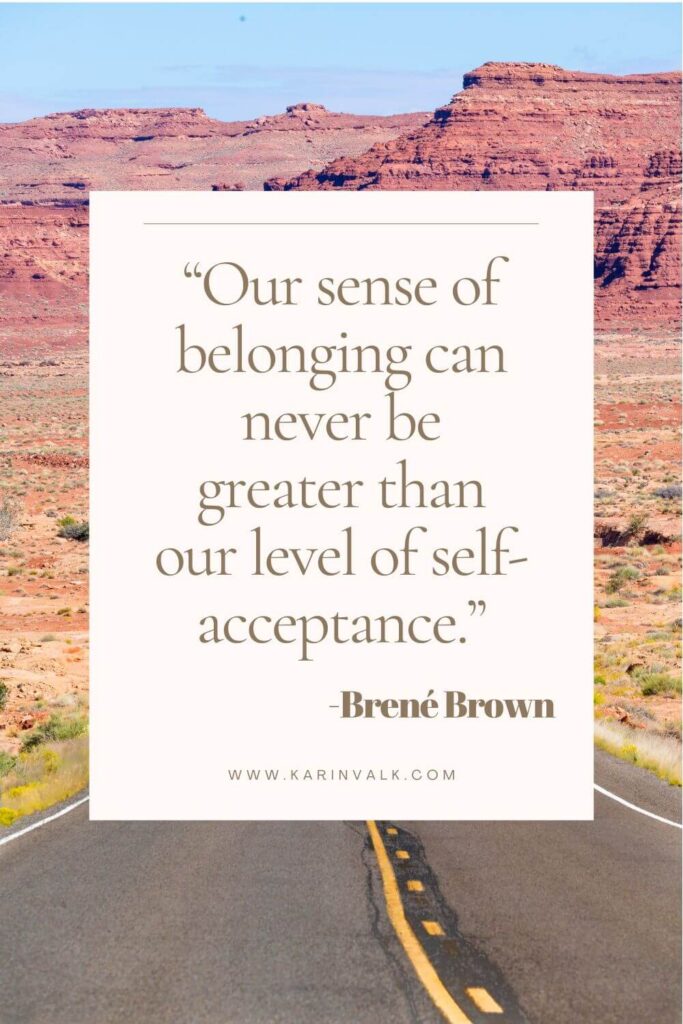
“Our sense of belonging can never be greater than our level of self-acceptance.”
And in a line that clearly distinguishes belonging from fitting in, she adds:
“Fitting in is about assessing a situation and becoming who you need to be to be accepted. Belonging is about being who you are.”
Other quotes about belonging echo this same longing for home, both externally and within ourselves. Poet and writer Maya Angelou writes:
“I long, as does every human being, to be at home wherever I find myself.”
And another powerful one by Maya Angelou:
“We may act sophisticated and worldly… we feel safest when we go inside ourselves and find home.”
Author Jhumpa Lahiri captures the frustration many people feel when belonging has never been straightforward in this not belonging quotes:
“The essential dilemma of my life is between my deep desire to belong and my suspicion of belonging.”
And children’s author Madeleine L’Engle offers a poetic reflection that resonates deeply for those who feel in between places or identities:
“We are all strangers, longing for home, but sometimes catching glimpses of it.”
Together, these quotes about belonging and quotes about not belonging don’t define belonging in a specific way. They reflect it as something deeply human and relational. I hope this gives you even the slightest bit more insight in how belonging is felt.
The Feeling of Not Belonging (And Why It’s So Common)
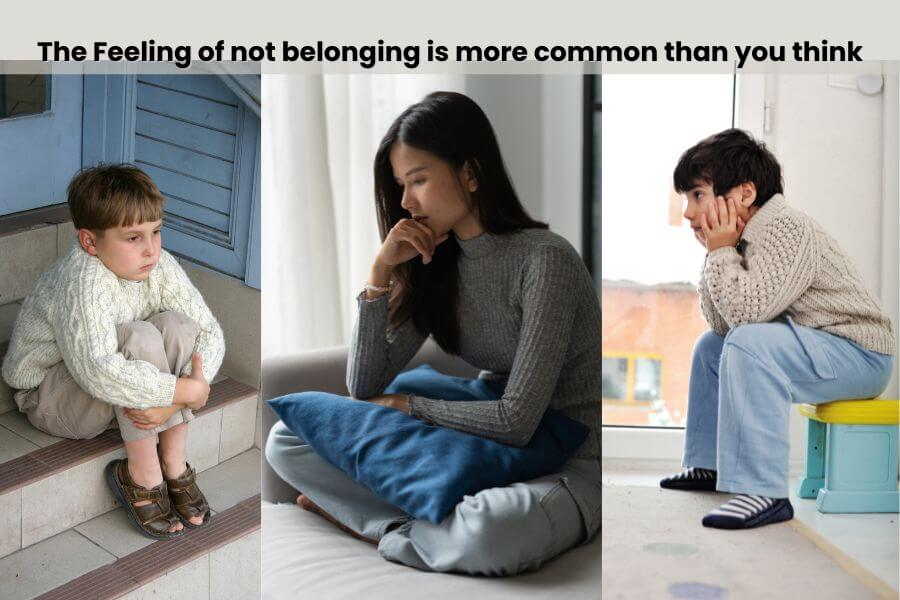
The feeling of not belonging is far more common than most people realize. In fact, many people don’t search for belonging because they feel secure in it; they search because they’re living with a sense of not belonging and trying to make sense of it.
This experience can show up as feeling out of place or unseen, even when you’re surrounded by others. You might have relationships, a job, or a community, yet still feel that something is missing. For some, it feels like always being slightly on the outside. Others might have no sense of belonging anywhere. Not fully at home in groups, places, or even within yourself.
What Is the Feeling of Not Belonging Called?
There isn’t one single word that fully captures the feeling of not belonging. Which is part of why it can be so unsettling. People describe it as loneliness, alienation, disconnection, or emptiness. But often it’s more subtle than those strong feelings.
It’s the ongoing questions of “Do I fit here?” , “What do others think of me?” or “Am I actually wanted, or just included?” happening in the background while you might not even be so consciously aware of it. There might even be a sense of anxiety or tension in your body that you’ve gotten used to so it’s not so noticeable anymore.
What’s important to say is this: experiencing a sense of not belonging doesn’t mean there’s something wrong with you. It often means your need for genuine connection and acceptance hasn’t been met in a way that feels real or sustainable.
Especially for people who have adapted often — socially, culturally, or emotionally — the feeling of not belonging can become familiar, even when it’s painful. Naming this experience can be helpful. When the feeling of not belonging is understood as a human response rather than a personal failure (which it’s absolutely not!), it becomes possible to meet it with curiosity instead of self-judgment.

Belonging vs Fitting In
People frequently talk as if the difference between belonging vs fitting in is subtle, but the way we experience these feelings shows how entirely different they are.
Fitting in is about adjusting yourself to match what’s expected. You scan the room, learn the rules, and shape yourself accordingly so you won’t be rejected. It can work socially, but it comes at a cost: parts of you stay hidden or carefully managed. Because of this constant monitoring (which may happen more or less consciously) your nervous system doesn’t get to relax.
Belonging, on the other hand, doesn’t require that kind of self-editing. As Brené Brown puts it, fitting in asks you to become who you need to be to be accepted, while belonging is about being who you already are. In other words, fitting in is effortful; belonging is relieving and authentic. Your nervous system feels safe to relax.
This is why people can be surrounded by others and still feel a sense of not belonging. You can fit in almost anywhere if you try hard enough. Belonging only happens where you feel safe enough to show up honestly, without negotiating away parts of yourself.
Understanding fitting in vs belonging often brings immediate clarity. A lot of people realize they haven’t failed at belonging at all. They’ve simply been very good at fitting in.
If you want to explore this difference in a more tangible way, there are beautiful resources that use stories to unpack what belonging really means versus simply trying to fit in.
How Do You Know If You Belong?
So, how do you know if you belong?
Many people expect belonging to feel certain or permanent, but it’s not necessarily a linear thing. A sense of belonging is often recognized in more subtle ways.
You might notice it when you stop questioning yourself so much, or when you don’t feel the need to earn your place in some way. The feeling of belonging tends to show up as ease — a sense that you can stay present in the moment without feeling tense or the need to perform.
You may also recognize belonging by contrast. If you’ve spent a long time adapting, fitting in, or holding parts of yourself back, belonging often feels like relief. Not because everything is suddenly perfect, but because something inside you can finally rest.
If you’re still unsure, that doesn’t mean you’re doing something wrong. Wondering about belonging is often a sign that you’re paying attention. To yourself, and to what actually feels true. And that awareness is where belonging, in its most honest form, begins.
And if you’re looking for practical, everyday support, this post shares practical ways to create a sense of belonging anywhere, even when it doesn’t come naturally.