
A visual timer for kids can save you from so many daily battles! From homework that won’t start to screen time that never ends. When kids can finally see time, everyday routines and transitions get easier for everyone. Below you’ll find the best visual timers for kids for every age and need.

A good visual timer for kids can make daily life with children so much smoother. I’ve seen it as a parent of two, a former international school teacher, and an embodiment coach. The trick is finding the one that fits your child, and there are some great options!
Below you’ll find my 12 favorite visual timers for kids. Including: a visual timer for the classroom, a visual timer for ADHD, visual timers for autism, a homework timer, a preschool timer for toddlers, and fun options for daily routines and screen time.
I’ll also cover what age visual timers are good for and whether a physical timer or a visual timer app works better, so you can choose quickly and get on with your day. And there’s a FAQ all the way below.
This post is all about finding a great visual timer for kids.
Visual Timer Benefits: How a Visual Timer for Kids Helps Every Child
The biggest of the visual timer benefits is a simple one: kids can finally see time. Time is invisible, and we ask children to manage it all day: “five more minutes”, “hurry up”, “we’re late”, and for a lot of kids those words don’t mean much yet.
A visual timer for kids shows the minutes as a shrinking colored disc, so a child can watch time pass on their own. That takes the pressure off you too, since you’re both looking at the same timer.
It’s a big help with transitions, like ending screen time or coming to dinner, because kids can see the change coming instead of being caught off guard.
Here’s what I love most, though: a visual timer helps different kids for different reasons.
- A young child hasn’t built a sense of time yet. Most can’t really grasp “fifteen minutes” until around age seven, so they need to see it to feel it.
- A child with ADHD deals with time blindness. Time genuinely doesn’t feel like it’s passing. Seeing it move makes starting and finishing so much easier.
- An autistic child usually feels calmer with predictability. Knowing what’s coming, and when, takes the worry out of a change.
- A child still learning the language can read the disc without needing the words for “almost done”. That’s a language thing, and has nothing to do with their sense of time. Easy to miss in a multilingual classroom.
So let’s get to the timers. I’ll point out what makes each one different as we go.
When the countdown isn’t coming from you, it’s easier to stay the calm person your child needs in a hard moment, which is really what co-regulation is all about.
Visual Timer for Classroom Use
A visual timer for classroom use has one job: to be seen from the back of the class. Why are timers good in the classroom? A visible countdown lets every student pace themselves and switch activities with less stalling. Transitions are smoother because the end of an activity doesn’t come suddenly.
Here are the two best visual timers for classroom use: one big, one giant.
1. Time Timer Original 12″: A Big Classroom Timer

The Time Timer Original 12″ is the go-to large timer for classroom use. Its refreshed white frame and high-contrast blue disk (depending on availability per country tho, could be different colors) read clearly from anywhere. It’s magnetic for whiteboards, and it is silent with an optional end-beep. So, a calm classroom timer for sensitive kids.
A dry-erase card makes first/then routines easy, and it works just as well on a kitchen wall at home.
2. Time Timer MAX: A Giant Classroom Timer

Need to fill a gym or auditorium? The Time Timer MAX is a giant classroom timer at a full 17 inches. It has eight duration settings (5 minutes up to 24 hours) and an alert you can set to silent, moderate, or loud.
Honest heads-up: it’s the only timer I found this large, and reviews are mixed. Some love it, some say theirs broke fast. Returns are easy, so it might be worth a try if you need the size.
Visual Timer for ADHD
A visual timer for ADHD helps with the thing that makes ADHD so tricky: time blindness. Do visual timers help with ADHD? Yes, it truly does. Kids with ADHD or ADD often can’t feel time passing, so seeing it move can take the pressure off starting and finishing a task.
That’s why visual timers for ADHD are one of the most recommended tools for a child with ADHD (and plenty of adults too). A 2025 study even found they lowered kids’ anticipatory anxiety and kept them more on-task, most of all for those at higher ADHD risk.
They help with focus, too: once a task has a visible finish line, an easily distracted child can get started with more ease. That’s what makes a visual timer for focus so useful for anything that needs sustained attention.
I’m obsessed with mine (I’ve got the cute green MOD one) and it’s helping me write and not forget to have lunch in this very moment.
A timer is just one piece of an ADHD-friendly setup. If your child wriggles and slides through every homework session, the right focus chair helps a lot too.
Related post: 11 ADHD chairs: The best chairs for improved focus
3. The Time Timer: A Classic Visual Timer for Kids
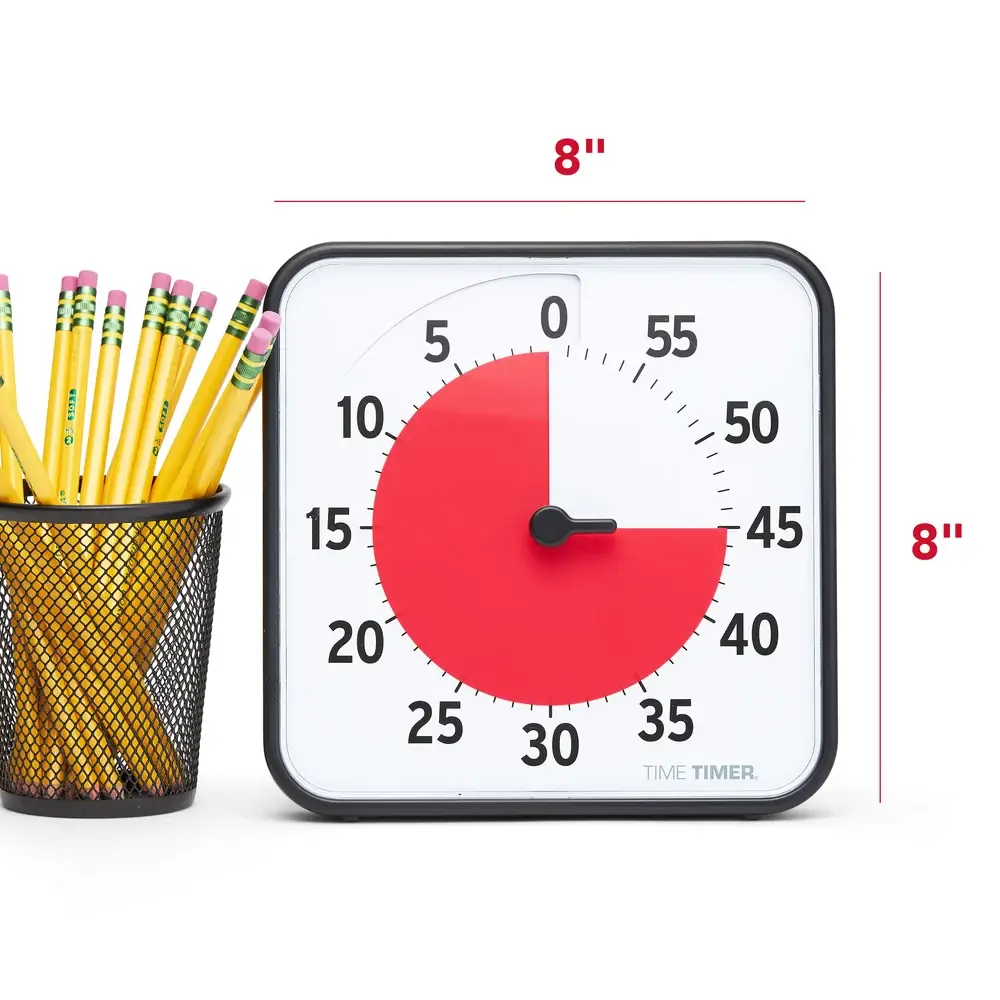
The Time Timer Original 8″ is the original Time Timer most people picture when they say “the real time timer”. As with the other visual timers so far, the red disk shrinks as time passes, and it’s silent with an optional end-beep. In addition, it’s magnetic with a foldable stand for a desk or whiteboard.
As a time timer for ADHD, its size is helpful. Easy to see across a room (and not filter out and forget it’s even there… yes, I’m speaking from personal experience. Don’t put it behind your laptop! haha). It still fits fine on a homework desk. It works just as well for adults with ADHD.
Visual Timers for Autism
Do visual timers help autistic children? Yes. Visual timers for autism work through one thing above all: predictability. An autistic child often feels most calm knowing exactly what is coming and when. Therefore, a shrinking disc shows that at a glance. Simple. Quiet. No sudden transitions.
Research on visual supports for autistic children backs this up, finding they lower anxiety and make transitions smoother across ages and settings.
You don’t need a special product here. Any of the silent timers on this list works. A visual timer for autism is best when it runs without loud ticking or a jarring alarm, so the classic Time Timer or a calm digital model are both great options.
Plenty of parents search for an autism time timer for exactly these reasons. A visual clock for autism on the desk turns the abstract feeling “five more minutes” into something a child can see and trust. For a lot of families, that’s what visual timers for kids with autism come down to: fewer surprises, and calmer changes.
A visual timer works best as part of a calm, sensory-friendly toolkit, and these sensory toys for autism are a great addition.
Related post: 17 Excellent Sensory Toys for Autism That Help All Kids
Homework Timer: A Visual Timer for Homework and Study
A homework timer solves the hardest part of homework: starting it. How do you use a visual timer for homework? Set it for a short, doable block — say fifteen or twenty minutes — and put it where your child can see it. Let the shrinking disc do the nagging so you don’t have to. When the time’s up, they get a real break. I encourage movement breaks!
Breaking work into visible chunks makes a timer for homework incredibly useful, as things actually get done!
I use mine all the time for 5 minute movement breaks too. They’re great when you use the Pomodoro technique, see video below if you’re unfamiliar. It’s very effective!
4. Time Timer MOD: A Compact Timer for Homework
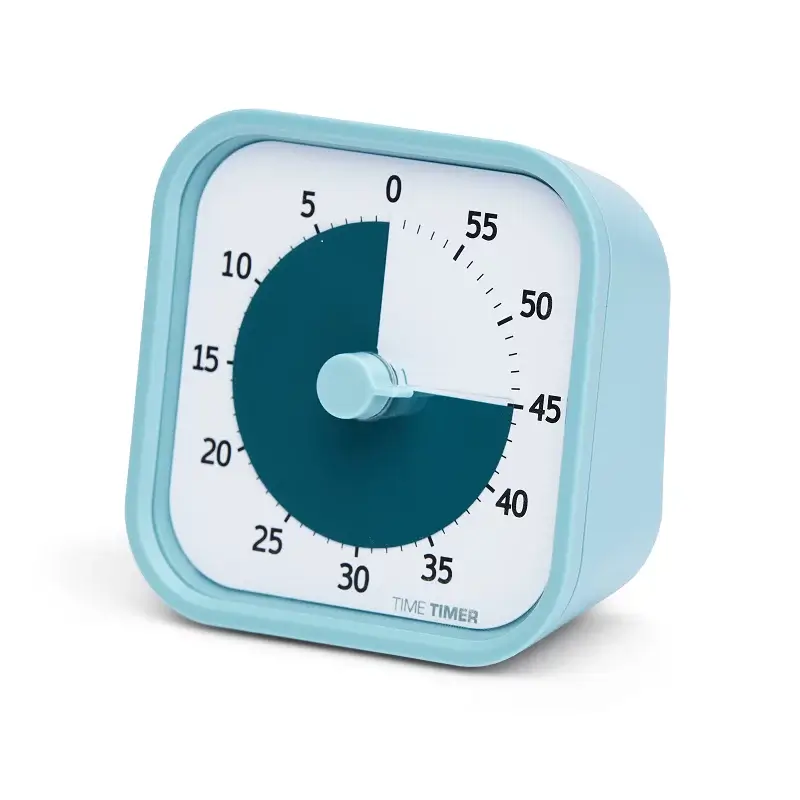
The Time Timer MOD is the desk-sized version of the classic. Just 3.6 inches (about 9 cm), light enough to live in a backpack (mine does on a regular basis). It is silent with an optional end-alert and you can get it with a removable silicone cover in a range of colors. I’ve got the cute fern green one as green is my favorite color. Many of you were probably dying to know that vital piece of information.
Anyway, as a timer for homework, its size is helpful. Small enough to be placed on a desk or table next to books and other study material.
If you’re looking to support your child to do their homework, this post has very useful tips:
Related post: 7 Smart Parenting Tips That Boost Study Motivation Fast
5. Pomodoro Timer Cube: A Visual Timer for Focus

For older kids and study sessions, a visual timer for focus that works like a pomodoro timer, helps. Short bursts of work with a timed break between (see the video above for the Pomodoro technique). The KADAMS pomodoro cube makes that effortless with their cool feature: you flip the cube so your chosen time faces up (5, 10, 25, or 50 minutes) and it starts on its own.
A big digital display shows the minutes ticking down inside a glowing LED ring. So, as a digital time timer it’s easy to read from across the room. A mute button keeps it silent for study. This countdown timer also counts up when you’d rather track how long something takes. Useful!
All in all, a fun, low-fuss study timer for homework and focus sessions.
Visual Timer for Toddlers and Preschoolers
A visual timer for toddlers has to be simple enough for very small hands and colorful enough to hold their attention. What age are visual timers good for? Around three is the usual starting point. That’s when a child can follow a color or a shrinking picture, even though they can’t read a clock or grasp what “ten minutes” means yet.
Besides that, keep the activities short and playful. A rainbow or a friendly character makes a great pre-k timer for the youngest ones.
6. Learning Resources Rainbow Timer: A Cute Preschool Timer
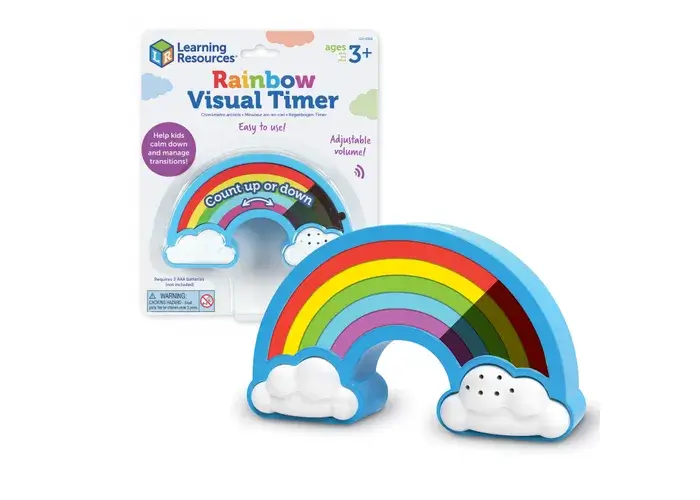
The Learning Resources Rainbow Timer is a lovely first preschool timer. Bright rainbow bands light up and fade to show time passing. It comes with easy presets (1, 3, 5, 10, or 15 minutes) a preschooler can almost set alone.
It also works well as a night-light that counts down to sleepy time. Hopefully this makes bedtime a little less of a negotiation! And a soft chime signals the end.
7. Doliwish Dinosaur Timer: A Pre-K Timer

If your little one loves dinosaurs, the Doliwish Dinosaur Timer is an absolute winner. I think it’s adorable! (I know I’m supposed to be an adult, but if I didn’t already have the MOD time timer, I’d get it, haha). It’s a rechargeable, silent kids timer that makes a lovely pre-k timer with a bright LED screen and a colorful progress ring. And it comes in many different colors.
Plus it has handy built-in settings especially for little kids, like a two-minute toothbrushing timer and a potty-training mode. Cute enough that a toddler wants to use it, which is definitely not unimportant with those strong-willed little humans. It also comes in a unicorn timer in case that’s more their jam.
Using a Visual Timer for Daily Routines and Screen Time
A visual timer for kids earns is a great tool to decrease small daily battles. For example, the morning routine, tidy-up time, screen-time standoffs, and the endless “five more minutes”. Setting a timer before screens go on gives everyone an agreed ending, so when the time’s up, the timer makes the call.
The same trick works for a homeschool day. I’ve heard people ask: are visual timers helpful for homeschool? Very much so, since a home learning day might be harder to add structure to or to move through transitions, without the “peer pressure” of classroom group dynamics. A visual timer can save the day!
This is also where I’ve collected the fun ones. For daily routines, the design matters more than you’d think. A child who picks their own timer is a child who’ll use it. Here are some of the cutest fun countdown timers for kids, with a shape for every personality.
A visual timer also belongs in a calm down corner, where it shows a child exactly how long their reset lasts — it’s one of my calm corner essentials.
8. Brainstream Rainbow Ride: A Fun Countdown Timer for Kids
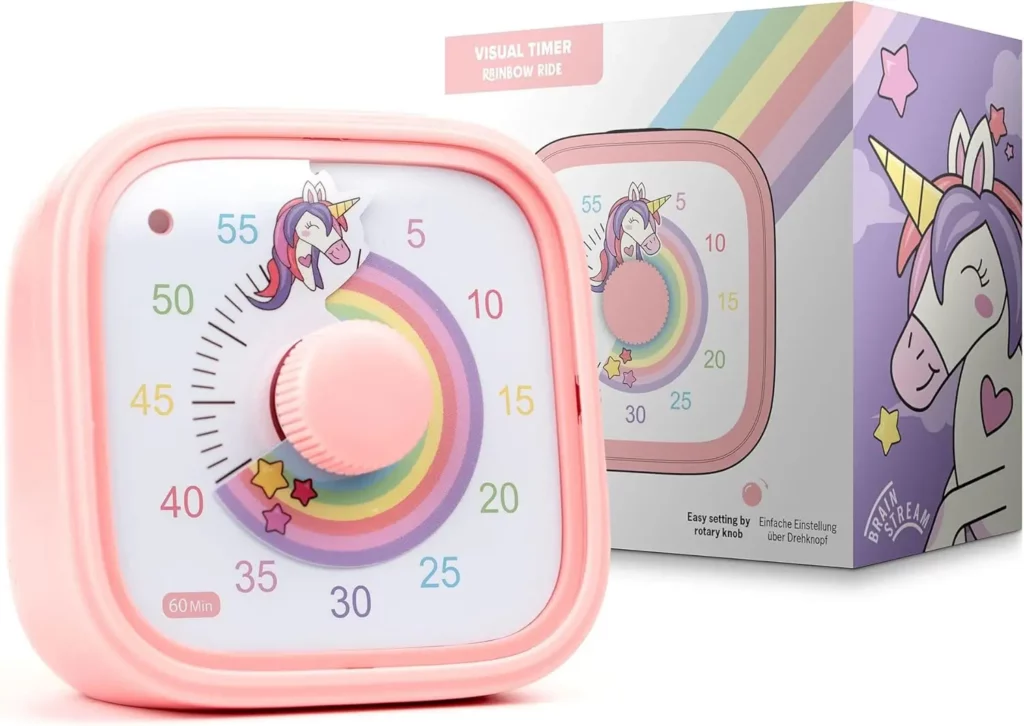
This unicorn timer is easily the prettiest of the bunch for any kid that loves pink and rainbows and unicorns. And I know a lot of them. For a lot of kids that’s the whole reason they’ll use it. The rainbow disc fades as the minutes go, with no need to read numbers, which suits younger children who aren’t ready for a clock yet.
9. Secura Fruit Timer: A Funny Countdown Timer
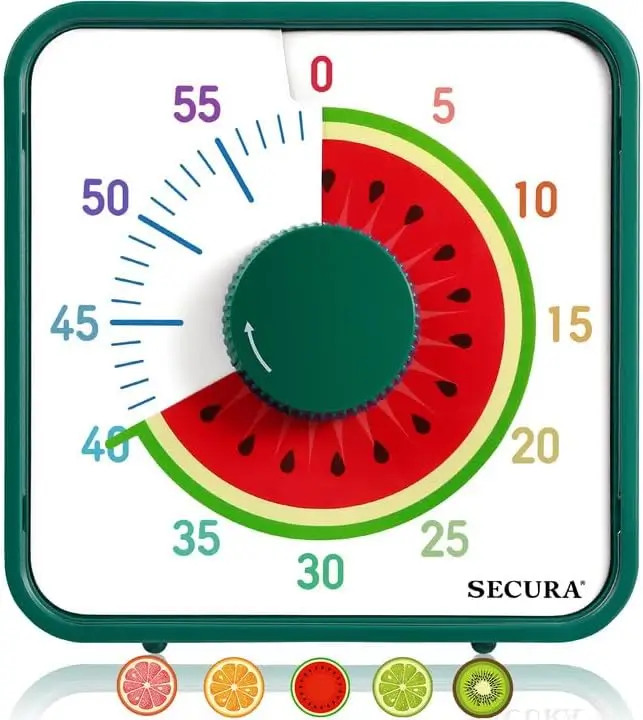
This oversized watermelon is a big 7.5 inches (19cm), so it’s easy to see across a room. Additionally, it’s fully mechanical, which means no batteries, no charging, ever. Which parents and teachers love because it’s one less thing to worry about.
One honest note from the reviews: it’s an old-school timer, so it ticks as it runs and the end-bell is loud, which makes it a poor fit for a sound-sensitive child. It’s from a small US business (good to support the small ones!), so the fruit designs (and a cute space version) go in and out of stock — worth grabbing your favorite when it’s there.
10. Owl Animal Timer: A Visual Timer for Kids
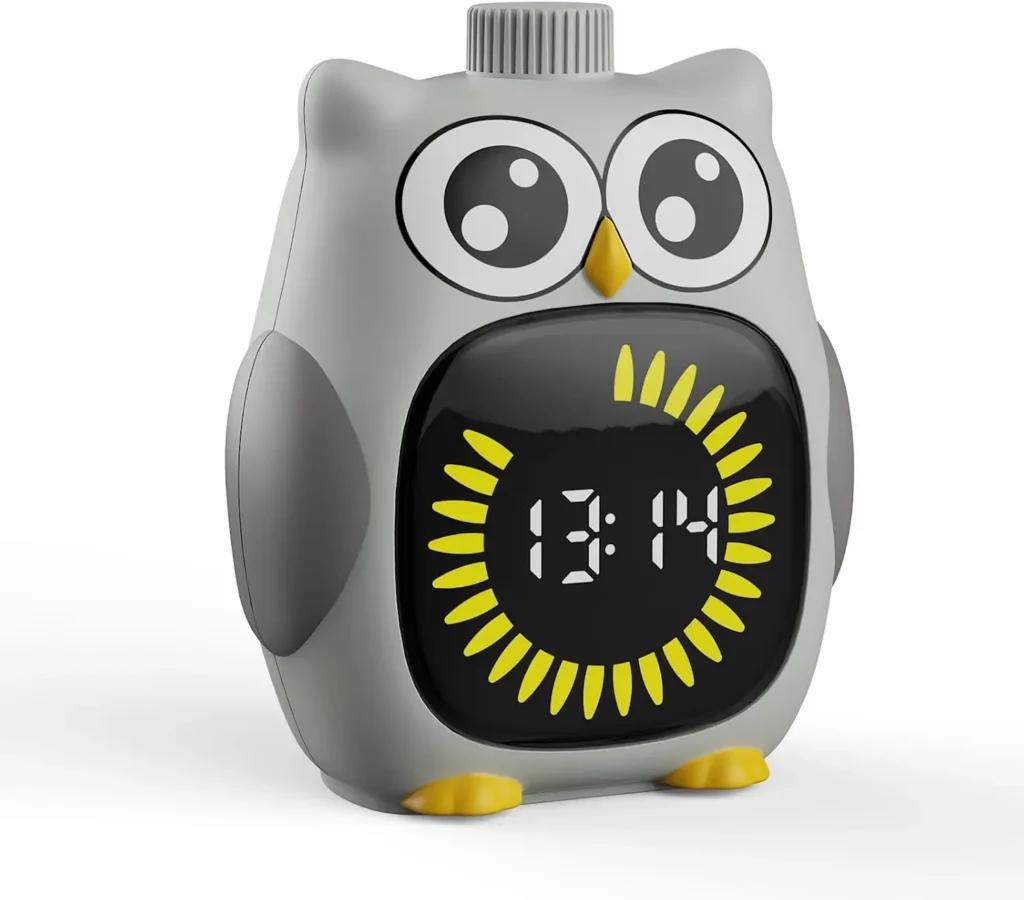
This wide-eyed owl is a cute visual timer for kids who like a bit of character on their desk. It counts all the way up to 99 minutes, a good bit longer than the usual hour. That extra range makes it genuinely useful for a child with ADHD working through a longer stretch, where time blindness can make an hour disappear in what feels like minutes.
Set it for a big clean-up or a full homework session, and the shrinking disc gives them something concrete to pace against. It works just as well as a visual timer for adults who lose track of time.
11. A Visual Timer Clock: Retro Version
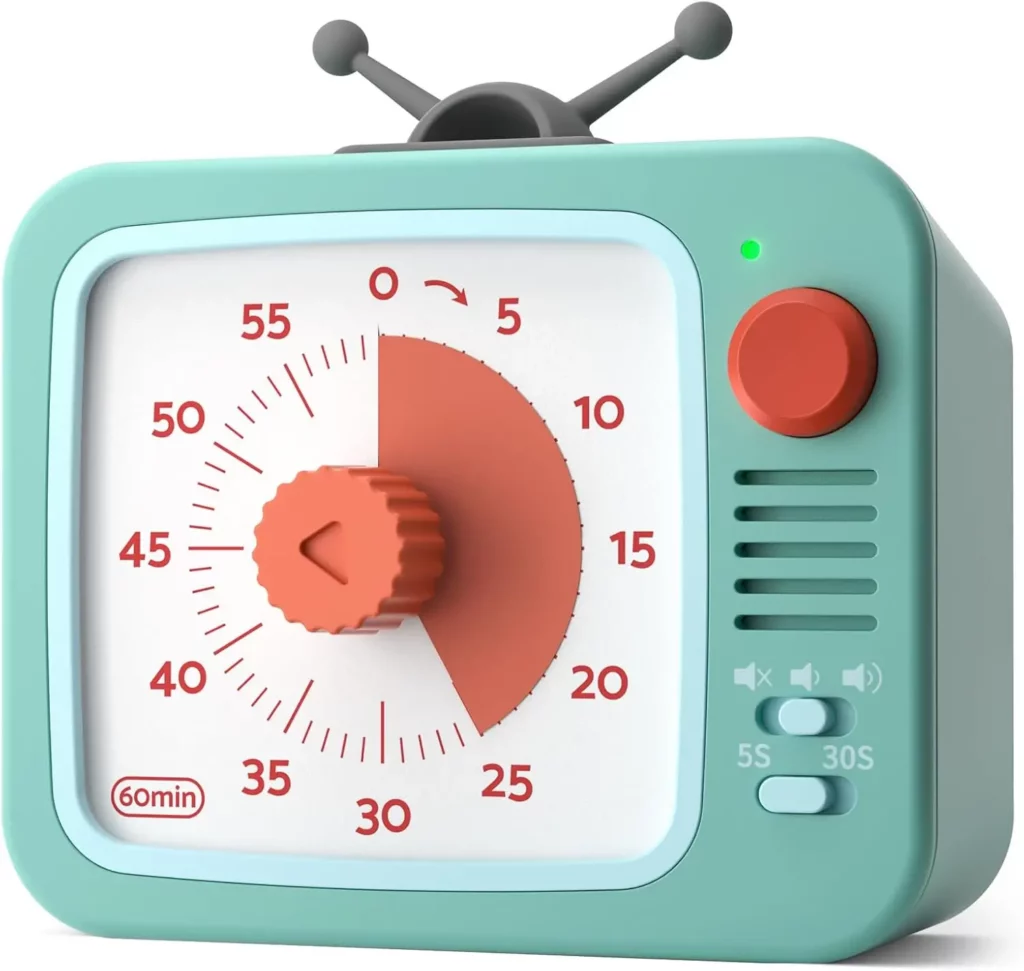
This unique Retro-TV Timer is a rechargeable timer clock. A rainbow disc tucked into a cute retro telly case that charges over USB, so you’re not forever swapping out tiny batteries. It even has a magnetic back so you can pop it on the fridge. Now it is a morning-routine timer the whole family can see, which makes it a great time management tool for building a daily rhythm.
For kids who need extra structure — whether that’s because of ADHD, autism, a language they’re still learning, or simply being a slow starter — seeing the same timer in the same spot each day makes mornings calmer and more predictable. I love using these clocks as a visual timer and adhd tool in one.
12. A Screen Time Timer for Kids: Space Themed Timer

This fun space timer is a spaceship-themed option for the kid who’d rather have a rocket than a rainbow, and it makes a great screen time timer for kids. When should you use a visual timer? Ideally, right before the tablet or TV goes on. Set the silent, non-ticking countdown, show your child how much is left, and the ending is clear from the beginning (I tend to set it 5 minutes before I need them to stop, so they have time to “quickly finish this level” or whatever. But do what works for you!).
It runs on batteries, and you can set the alarm to high, low, or mute. It might be worth knowing that reviewers find even the low setting fairly loud, so mute is your friend with a sound-sensitive child. Parents of kids with ADHD rate it highly for exactly this kind of screen-time and transition wrangling.
How to Choose the Best Visual Timer for Kids
Choosing the best visual timer for kids comes down to a few honest questions. What should you look for when buying a visual timer? Start with sound. Especially for a neurodivergent or sound-sensitive child, a silent timer with an optional or mutable alarm is crucial.
Then size, from a big classroom time timer everyone can see from the back of the room to a compact one for a homework desk.
Then format: a fun visual timer for young kids, a digital display for older ones who want the exact minutes, or an app if you’re already on a screen.
And durability, since a timer a child handles every day needs to survive a few things. A timer your child helps choose is the one they’ll more likely use.
As for the goal and function, a visual timer for students, teachers, homeschoolers, adults, and little ones are the same: time management. Whichever shape or form, is up to personal preferences!
Real Time Timer
Plenty of people search for a “real time timer”, and what they usually mean is the genuine product: the Time Timer brand, the original Time Timer clock that the cheaper lookalikes are copying. If you want the real Time Timer, the Original (8″ or 12″), the MOD, the Time Timer Plus, or the MAX for a classroom, they’re all listed first in this list. If you specifically want a real time timer with seconds, that’s a job for a digital model of a different brand. In this list, the pomodoro cube and the owl shaped timer count down in minutes and seconds, up to 99:59.
FAQ About Getting a Visual Timer for Kids
A visual timer is a clock that shows time as a shrinking coloured disc or bar, so we can see how much time is left without reading any numbers. As the colour disappears, so does the time, which is why even a toddler can “get it”. Most of the timers in this roundup are this kind of visual time timer for kids. They are amazing for productivity and predictable transitions.
A regular timer only makes a sound when time runs out, so a child has no idea how long is left until it beeps. A visual timer shows the countdown the whole way through, which is what makes it so much calmer for kids who struggle with time blindness, or with sudden transitions.
A sand timer is visual too, but it only does one fixed length and can’t be paused. A visual timer lets you set any duration up to an hour or more, sometimes can be stuck to a fridge, and the main thing: it shows time like on a clock with a moving disc. So if you set a 15 minute timer on a 60 minute visual clock, it actually shows as a quarter of an hour disappearing. That’s much more clear and predictable than a sand timer.
For most kids, the best visual timer for ADHD is the classic Time Timer or a very similar one: silent, simple, and showing time shrink at a glance, which is what helps with ADHD time blindness. The same disc works whether you’re using timers for ADHD for homework and chores or as a visual pomodoro timer for ADHD during study.
Older kids and adults sometimes prefer a digital visual clock for ADHD that shows the exact minutes. Really, the best visual timer for kids with ADHD is the one they’ll use. I like to use mine because I love the color so I enjoy having it around. So, it’s a visual timer and ADHD tool in one! And for anyone learning how to be on time with ADHD, making time visible is super helpful, since ADHD time issues come down to not feeling time pass.
For most children, a physical timer beats a visual timer app, because the app lives on the very screen you’re trying to limit. A standalone timer has no notifications to pull them off task. Apps still have their place, though: a free time timer online or a classroom timer online for a quick one-off, a Time Timer desktop app for someone at a computer, a date and time timer built into a digital clock, or a visual timer watch on your wrist. It depends on your needs!
Yes, they definitely can be. Visual timers for autistic kids work by making change predictable, which lowers the anxiety around transitions. A visual timer for autistic kids shows exactly what’s coming and when, without needing any words, so it’s a favourite in many special-education classrooms and homes.