SEL books are one of the easiest and most powerful ways to teach kids about emotions. Whether you’re reading aloud in an international classroom or snuggled up at home, the right story can help children recognize, name, and manage big feelings in a way that feels playful and safe.
This post contains affiliate links to Bookshop.org (they support local bookstores!), and as an Amazon associate I earn from qualifying purchases, which means I may earn a small commission at no extra cost to you.
If you’ve ever felt stuck trying to explain emotions like anger, worry, or sadness to a child, you’re not alone. Social-emotional learning (SEL) can feel abstract. But fear not! The right SEL books make it concrete, relatable, and even fun.
In this post, I’m sharing 12 of the best books to teach emotional regulation, especially helpful for multilingual kids, ESL learners, and early childhood educators. They’re great SEL books for elementary students whether you use them at home or in the classroom.
You’ll also find tips on how to make these books for social emotional learning more accessible for your students or children. Whether English is their first language or not. From simple read-alouds to deeper emotional conversations, these SEL books for kids help lay the foundation for empathy, self-regulation, and emotional vocabulary.
This post is all about SEL books: the best books to teach emotion regulation.
Why Use SEL Books to Teach Emotional Regulation?
Reading stories about feelings gives children a safe way to see themselves—and others—navigate emotions. That’s why social emotional learning books are such a helpful tool for both home and classroom environments. They make abstract emotional concepts more concrete and relatable, and they allow kids to reflect on feelings without being put on the spot.
For multilingual learners, books about social emotional learning offer even more value. They help connect emotional understanding with new vocabulary, visual cues, and familiar storytelling patterns. Many of the books on emotional regulation featured in this list also include vivid illustrations, repeated phrasing, or predictable structures. Making them ideal for children who are still building English proficiency.
Whether you’re a teacher looking for picture books for social emotional learning, or a parent hoping to support emotional growth at home, these carefully chosen stories support emotional vocabulary, self-regulation, and social connection.

How to Choose the Right SEL Books
Choosing the right SEL books for kids can feel a bit like picking out the perfect watermelon: you don’t really know what’s inside until you crack it open. But there are some helpful clues to guide your choices when choosing the best sel books for elementary students – at home or in the classroom.
Here’s what to look for:
- Simple, emotionally clear language
For younger kids, especially preschoolers or ESL learners, choose books with clear, consistent emotional vocabulary. Repetition is your friend here. Not just for comprehension, but for emotional safety, too. - Visuals that match the story
Books like The Color Monster or My Many Colored Days use color, expression, and visual metaphor to help children connect emotion with imagery. Especially helpful for ESL learners who benefit from strong visual support. - Stories with relatable emotional arcs
Whether it’s calming down, making a choice, or managing big feelings, look for books where the character actually goes through the emotion. Kids see themselves in the process, and learn that it’s normal to feel a little (or a lot) all over the place. - Grade-appropriate depth
For kindergarten and early elementary, SEL books that name emotions directly and use a single storyline work well. For Grades 3–5, you might look for books with more layered themes like inclusion, empathy, or choices with real consequences.
Bonus tip: If a book makes YOU pause and reflect, it’ll probably be amazing in your classroom or home too.
Whether you’re stocking a calm-down corner or prepping your next social emotional learning read-aloud, this list includes a mix of books. Suitable for different ages, levels, and language needs. And if one of them sparks a conversation that starts with you sharing a personal memory such as: “Remember that time I got that mad?”, then you’ve nailed it.
Looking to create a cozy, regulation-friendly space?
Check out these calming classroom decor ideas that support emotional regulation.
12 Best SEL Books to Teach Emotional Regulation

1. Pete the Cat and His Magic Sunglasses: A Fun, Uplifting Book About Optimism and Self-Regulation
If you’re looking for social emotional learning picture books that teach emotional regulation without it feeling like a lesson, then this is a great one. In this story, Pete the cat starts off grumpy, until he puts on a pair of magic sunglasses that help him see things more positively. Along the way, he meets other characters having tough days and helps them shift their perspective, too.
It’s bright, playful, and sneaks in an important message: your feelings might be valid, but your mindset can shift things. This book is especially fun as a read-aloud for preschool and early primary kids. It has bold illustrations and predictable patterns that make it great for multilingual learners.
Available on Amazon or Bookshop
Supports: optimism, reframing negative emotions, and social connection
Best for: Ages 3–7, ESL classrooms, morning meetings, or “meh mood” days.

2. The Color Monster: A Social-Emotional Learning Book for Preschoolers and ESL Learners
Who says emotional regulation books are only for older kids or adults? This gentle, visual book introduces young learners to emotions using colors: yellow for happiness, red for anger, blue for sadness, and so on. The Color Monster is feeling all mixed up, and a kind friend helps him name and sort his feelings.
It’s one of the most widely used SEL books for and kindergarten and preschool, and for good reason! The visual metaphors are powerful, the language is simple, and the message is clear. Multilingual learners benefit from the color-emotion associations, and teachers love using this as part of their calming classroom activities.
Tip: you can easily extend this with emotion sorting cards, drawing activities, or home language connections.
Available on Amazon or Bookshop
Bonus find: In the Bookshop link you’ll also spot a Korean version of this story and even a coloring book! Perfect for multilingual families or extra classroom fun. I loved stumbling on those!
Supports: identifying emotions, color-emotion association, and sorting mixed feelings
Best for: Preschool and kindergarten, social emotional learning in ESL classrooms, and emotion vocabulary activities.
Let’s keep going. Anger issues anyone?

3. When Sophie Gets Angry—Really, Really Angry: A Powerful Picture Book About Emotional Regulation for Grades 1–3
Sometimes kids (and adults, let’s be honest) just snap. This beautifully illustrated book follows Sophie as she has a huge emotional meltdown: slamming, screaming, and storming off, and then slowly finds her way back to calm.
What makes it stand out? It doesn’t shame the explosion. It just shows it. And it gives space for kids to talk about what it’s like to feel that big and overwhelmed. For children who struggle with self-regulation, or who come from cultures where emotional expression is viewed differently, this book can be incredibly validating.
Available on Amazon or Bookshop
Supports: managing anger, emotional expression, and cultural variation in how kids process big feelings
Best for: Grades 1–3, multilingual and neurodiverse classrooms, emotional safety conversations

4. My Many Colored Days: A Visual SEL Book to Explore Emotions and Color with Young Learners
Originally written by Dr. Seuss, this poetic book links each emotion to a color and an animal. For example, a bright yellow buzzing bee for happy, or a sad blue quiet fish for down days. While it doesn’t name emotions directly, the rhythm and imagery make it a powerful emotional vocabulary tool for children who are just learning to express themselves.
It’s also a great option for multilingual learners and ESL classrooms, since the visuals carry so much meaning. The metaphors invite creative follow-up: drawing, acting, matching feelings to animals or colors in other languages… the possibilities are endless.
Available on Amazon or Bookshop
Available in variety of formats for a wider age range, including a Hebrew edition for older readers on Amazon.
Supports: emotional self-awareness, metaphorical expression, and sensory-emotion connection
Best for: Preschool and elementary school, ESL settings, cross-linguistic emotion exploration
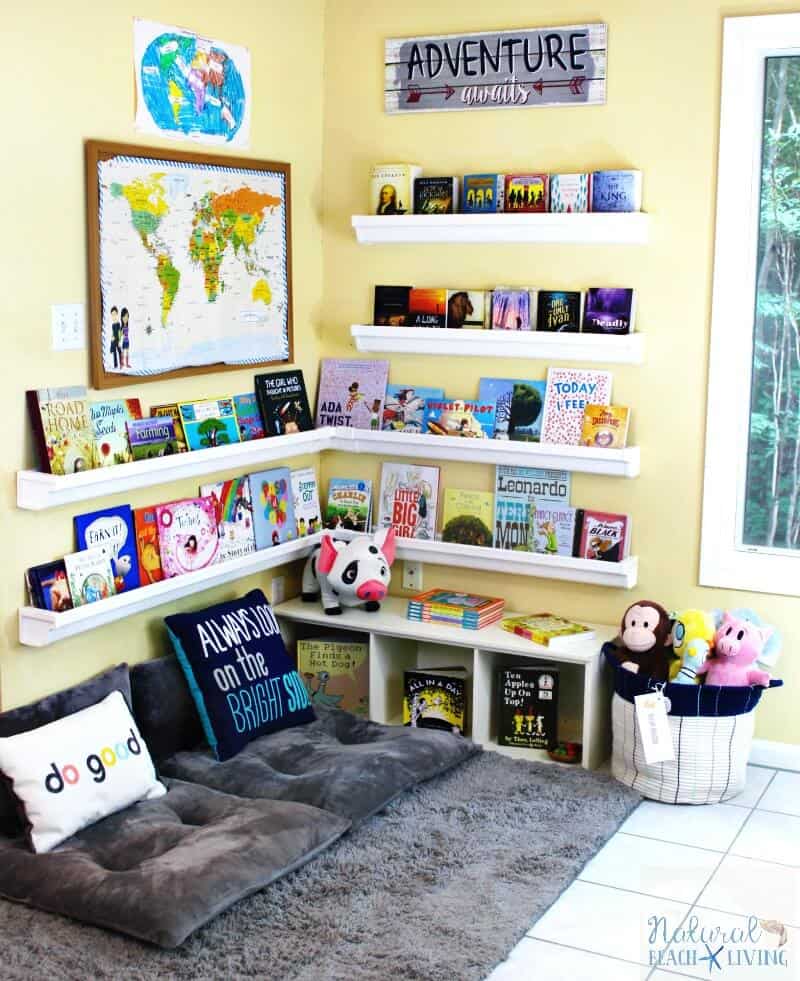
I love this cute little reading nook with front-facing shelves. So easy for kids to see their favorites and read independently! I also love this 3-tier Montessori bookshelf with front-facing shelves as well.

5. In My Heart: An SEL Book of Feelings That Builds Emotional Vocabulary in ESL Kids
This beautifully illustrated book breaks down feelings with a blend of lyrical language and sensory descriptions. It describes how each emotion feels inside the body: sharp, fluttery, heavy, or bubbly. The heart-shaped cutouts are a visual and tactile bonus, especially for younger learners.
It’s a lovely way to introduce emotional vocabulary in a way that sticks. The poetic tone also makes it a strong candidate for older ESL learners who are still developing confidence with emotional expression in English. This is one of those SEL books that works across ages, and it’s often included in collections of feelings picture books for social emotional learning.
Available on Amazon or Bookshop
Supports: emotional vocabulary, describing physical sensations, and building emotional nuance
Best for: Ages 4–7, multilingual kids, calm-down corners, and writing extensions

6. Listening to My Body: A Mindful Book About Self-Regulation Through Sensation
This is one of those self-regulation books that centers body awareness. Unfortunately, this is something often overlooked in conversations about feelings. It helps children notice physical cues linked to their emotions (“My belly feels tight,” “My hands feel tingly”) and introduces calming strategies like stretching or breathing. It’s a gentle, accessible way to teach emotional regulation to kids who may not yet have the words, but can tune into how their body feels.
For multilingual learners or neurodiverse students, this book bridges language and sensation beautifully. It also pairs well with this printable emotional regulation activity. A quick reflective activity that helps kids become aware of their posture and choose how they want to feel using body cues. A lovely extension for any embodiment or emotional regulation practice.
Available on Amazon or Bookshop
Supports: body awareness, self-regulation through movement, and noticing emotional cues
Best for: Ages 5–8, regulation stations, ESL and neurodiverse learners, SEL + embodiment crossover moments

7. What Should Danny Do?: A Choose-Your-Path Book About Choices and Consequences
If your students or kids love making decisions (and then immediately regretting them), this book is a gem. What Should Danny Do? uses a choose-your-own-adventure format that puts the reader in control of Danny’s day. Will he yell when things don’t go his way? Will he take responsibility? Will he eat the pancakes?! (Yes, that’s actually a plot point.)
What makes this a strong SEL book is that it shows how different choices lead to different outcomes, without shaming. It’s engaging, empowering, and sneakily effective at teaching self-regulation and social emotional learning skills in a classroom or home setting.
Available on Amazon or Bookshop
Supports: decision-making, self-control, and learning from consequences
Best for: Grades 1–3, small group discussions, ESL-friendly with teacher guidance

8. The Way I Feel: A Simple SEL Book About Emotions for Early Learners
This classic picture book uses bold illustrations and rhyming text to name emotions like happy, sad, jealous, and frustrated. It’s straightforward, which is exactly why it works so well; especially with preschoolers, ESL learners, or kids who need consistent exposure to emotion words in context.
Pro tip: don’t be surprised if a child interrupts your read-aloud to say, “I feel like THAT sometimes!” (Cue the tiny emotional breakthrough of the day).
Available on Amazon or Bookshop
Supports: labeling basic emotions, normalizing big feelings, and expressive language
Best for: Preschool–Grade 1, circle time, multilingual classrooms, vocabulary-building routines
Ready for another classroom favorite?

9. A Little SPOT of Emotion Box Set: Visual, Playful, and Surprisingly Deep
This boxed set includes several books, each starring a different “Little SPOT” that represents a feeling: happiness, sadness, anger, love, and more. The characters are simple and colorful, but the lessons? Surprisingly effective. Each story helps kids name the emotion, understand when it might show up, and learn what to do about it.
It’s one of the most teacher-loved self-regulation books on the market. The visuals make it perfect for early years and ESL settings. If you’re looking for SEL books for kindergarten that are concrete, repeatable, and fun to revisit during transitions or morning meetings, this set really delivers. Many teachers use it in emotion books baskets or regulation stations alongside printables or choice cards.
Available on Amazon or Bookshop
Supports: emotion identification, self-regulation strategies, and visual learning
Best for: Kindergarten–Grade 3, regulation stations, ESL classrooms, and group work

10. The Rhino Who Swallowed a Storm: A Beautiful Book About Healing from Big Feelings
Written by LeVar Burton, this gentle, metaphor-rich story begins with a young mouse upset by a recent storm. Both outside and inside. His grandfather reads him a story about a rhino who swallowed a storm of pain, fear, and sadness, and slowly learns to release it by receiving help and hope from others.
This book is perfect for addressing social emotional learning through the lens of grief, fear, or trauma. Especially with kids who may not know how to express what they’re holding inside. The story is layered, comforting, and respectful of big emotions. If you work with multilingual learners navigating transitions, this story may feel especially meaningful.
Watch it here: Enjoy this warm and comforting read-aloud by LeVar Burton. Perfect for a class share or bedtime story.
Available on Amazon
Supports: emotional healing, grief, asking for help, and hope-building
Best for: Grades 2–5, bedtime or quiet-time reading, international school transitions, social emotional learning conversations

11. Breathing Makes It Better: A Calming Book for Emotional Regulation and Mindfulness
This soothing, rhythmic book pairs emotions with simple breathing techniques. Each page introduces a different feeling—like anger, fear, or worry—and then gently guides the reader to “breathe in… and breathe out” as a way to move through it.
It’s one of the most approachable emotional regulation books out there and an excellent tool for teaching emotional regulation in a child-centered way. The visuals are warm and inclusive, and the script-like text makes it perfect for repeating often. Because let’s be real, we all need that reminder sometimes.
Available on Amazon or Bookshop
Supports: mindfulness, breathing strategies, and moving through discomfort
Best for: Preschool–Grade 3, calming corners, preschool classrooms, and mindfulness or SEL routines

12. The Invisible Boy: A Book That Teaches Empathy and Inclusion
Brian is the kind of student many teachers recognize immediately: quiet, often overlooked, never the one picked first. But when a new student joins the class and Brian shows him kindness, things begin to change.
This is one of those social emotional learning books that stays with readers long after the last page. It opens the door to meaningful discussions about empathy, inclusion, and how even small gestures can help someone feel seen. It’s especially impactful in ESL settings, where children may be navigating not only language differences, but also cultural or social barriers.
Available on Amazon or Bookshop
Click here for the Spanish version on Bookshop
Supports: empathy, inclusion, friendship, and classroom belonging
Best for: Grades 2–5, international classrooms, ESL settings, and SEL curriculum starters

Bonus SEL Books Pick: Honorable Mention
I’ve used The Day the Crayons Quit in class more than once, and it always sparked such fun and thoughtful conversations. The kids loved imagining what their crayons might be feeling. And I’ll admit, I had a soft spot for the beige crayon’s existential crisis. While it may not be a typical social emotional learning book, it’s brilliant for exploring emotional vocabulary, perspective-taking, and playful self-expression.

The Day the Crayons Quit: A Fun, Creative Story That Teaches Emotional Expression
This wildly popular picture book brings crayons to life. Each with their own emotional complaint. Red is overworked. Beige is jealous. Black feels underused. The result? A hilarious and surprisingly powerful story about emotions like frustration, loneliness, and feeling misunderstood.
It blends storytelling and humor with rich emotional themes, making it a playful but effective social-emotional learning book in its own right. If you want a crowd-pleaser that opens the door to real emotional conversations, this is your pick.
Available on Amazon or Bookshop
Available in Chinese on Bookshop.org.
Supports: emotional expression, perspective-taking, and self-advocacy
Best for: Kindergarten–Grade 4, writing prompts, expressive language lessons, and group discussions
Want a shortcut to all my favorites in one spot?
Final Thoughts on Using SEL Books for Emotional Regulation
Whether you’re stocking your classroom library, building a bedtime book basket, or just looking for new ways to connect with kids through stories, these SEL books for kids offer something meaningful on every page. I hope this list helped you discover a few new favorites; and that the tips throughout make them even easier to use with multilingual learners, ESL students, or your own children.
If there’s a book you love that’s not on the list, I’d genuinely love to hear about it!