
Ever wonder why a child can’t sit still, yet also can’t tell when they’re hungry or upset? Two hidden senses hold the answer, and understanding interoception vs proprioception is simpler than those long words suggest.
I earn commissions when you shop through the links below at no additional cost to you. As an Amazon Associate I earn from qualifying purchases.
I sometimes include Amazon links because I know ease and accessibility matter—especially for busy parents and teachers—but I’m also working on adding more options from smaller or values-aligned businesses. I’ll keep updating this post as those become available.
Big behavior and confusing body cues can leave anyone guessing, whether you’re a parent, a teacher, or working out your own reactions. As an embodiment coach and former international school teacher, I help kids and adults reconnect to what their bodies are telling them. So in this post, I’m breaking down interoception vs proprioception in plain, everyday language.
You’re going to learn what the 8 senses are, where the hidden senses fit, what proprioception and interoception each do, how they differ, how they work together, and what interoception and proprioception difficulties can look like in autistic and ADHD kids (and adults) — and more.
After reading this, you’ll know exactly what these two hidden senses are, how to spot them, and how to explain them to anyone: a child, a colleague, a parent, or yourself.
This post is all about interoception vs proprioception, made simple.
What Is Interoception vs Proprioception?
Interoception vs proprioception comes down to the inside versus position of the body. Proprioception is your sense of where your body is and how it’s moving. Interoception is your sense of what’s happening inside your body: hunger, thirst, a pounding heart, a full bladder, etc.
Both are hidden senses, both do what needs to be done without you thinking about them (ideally), and both are easy to mix up. That’s exactly why it helps to see them side by side.
No need to memorize this yet. We’ll build it up step by step, starting with the bigger picture of all 8 senses, then looking at each one on its own, before comparing them properly.
What Are the 8 Senses? Meet the Hidden Senses
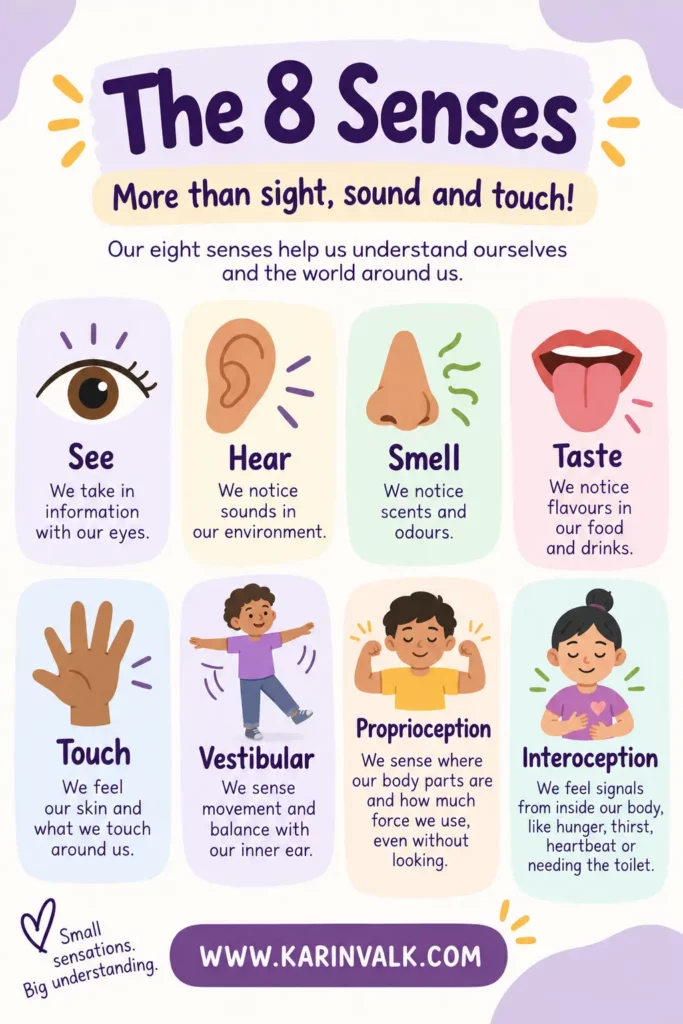
Most people can name five senses, but there are 8 senses in total. The three you were never taught are the hidden senses. These mystery ones work in the background even though they shape how a person feels, focuses, and copes all day.
These hidden senses do a lot of heavy lifting. They tell you where your body is, what’s happening inside it, and whether you’re upright or tipping sideways. Because no one names them in school, they stay invisible, running the show from behind the scenes.
Understanding the 8 senses is the first step to understanding interoception vs proprioception. Once you can see the whole set, the two senses we’re comparing are far easier to place and recognize.
A Quick Look at the 8 Sensory Systems
Here are the 8 sensory systems, briefly:
- Sight, hearing, smell, taste, and touch; the five you already know.
- Proprioception: the sense of body position and movement.
- Interoception: the sense of what’s happening inside your body.
- Vestibular: the sense of balance and head position.
That covers the whole set. The last three are our focus, because they cause the most confusion and the biggest “oh, that explains it” moments.
The Three Hidden Senses: Proprioception, Interoception, and Vestibular
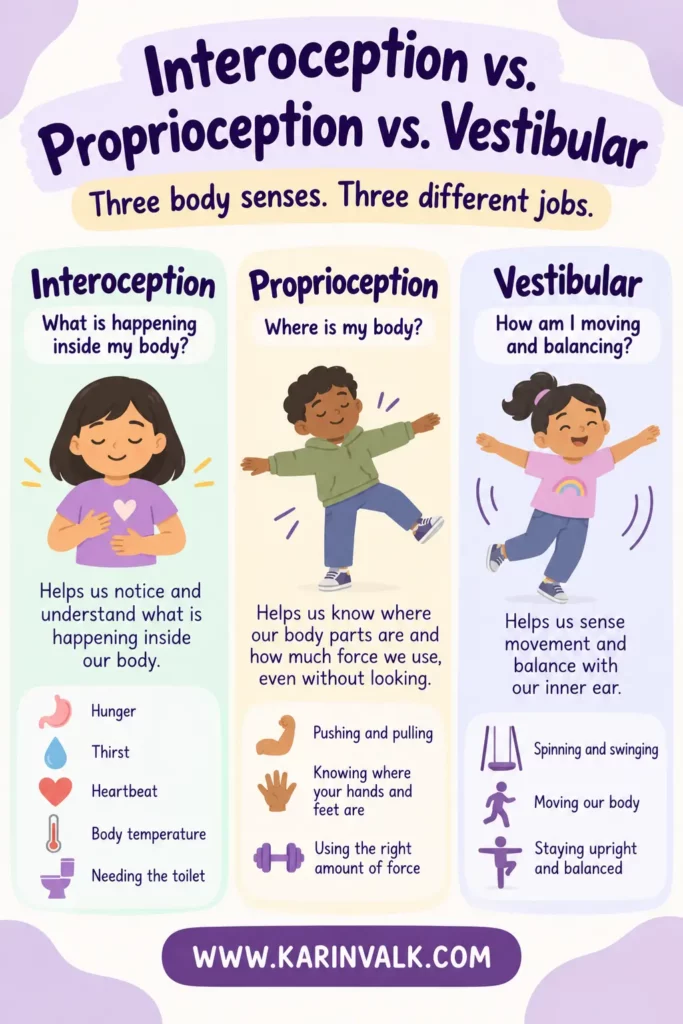
The three hidden senses are proprioception, interoception, and vestibular. Proprioception lets a child climb stairs without watching their feet. Interoception tells them their bladder is full or their heart is pounding. Vestibular keeps them balanced when they spin, swing, or tip their head back.
We’ll dig into proprioception and interoception next. Vestibular works closely with both, but it’s a story for another post (I won’t leave you hanging, I promise).
If you’re looking for fun proprioceptive activities to support your kids, this is a must-read:
What Is Proprioception, and Why Is It Important?
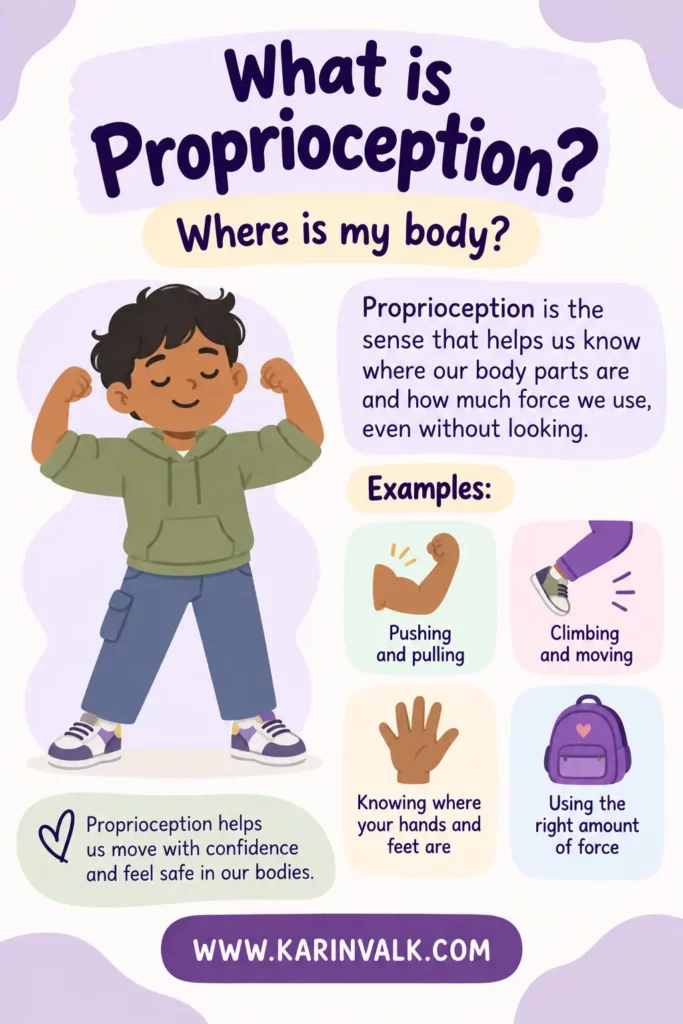
So what is proprioception, and why is it important? Proprioception is your body’s sense of position and movement, sometimes called the “body awareness” sense. It’s how you climb stairs without looking at your feet, judge how hard to grip a pencil, bring a fork to your mouth in the dark, or catch yourself when you stumble.
STAR Institute, a sensory-health organization, describes it as the system that senses “the position, location, orientation, and movement of the body muscles and joints.”
When proprioception works well, you barely notice it (which is precisely why nobody ever thanks it). When it’s less reliable, a child can look clumsy, use too much or too little force, bump into furniture, or seem unaware of their own body.
Proprioception in the Classroom
I saw this years ago during an internship in a kindergarten class. One boy was lying on the floor, and another child tripped right over his leg. He didn’t notice. It happened more than once, in different ways, until I told my mentor: “It’s like he doesn’t realize where his limbs are in space”. She said I’d nailed it.
I didn’t have the word proprioception back then, but that’s exactly what I was seeing: a child who couldn’t quite feel where his own body was.
So here’s why proprioception matters so much. A child who can’t feel where their body is has to work it out the hard way. They lean on their eyes and burn extra energy just to do what other kids do without thinking. Some only notice the chair once they’ve walked into it (been there). Sitting still, keeping hands to themselves, waiting in line, and crossing a busy classroom without a pile-up all get harder.
Strong proprioception helps to feel calm and focused, freeing a child up to listen, learn, play, and enjoy the day.
Some kids crave this kind of body input, and they calm down fastest once they get it. If that sounds like a child you know, the right sensory tools can help them feel where their body is.
Related post: 17 Excellent Sensory Toys for Autism That Help All Kids
What Is Interoception? Meet the 8th Sense
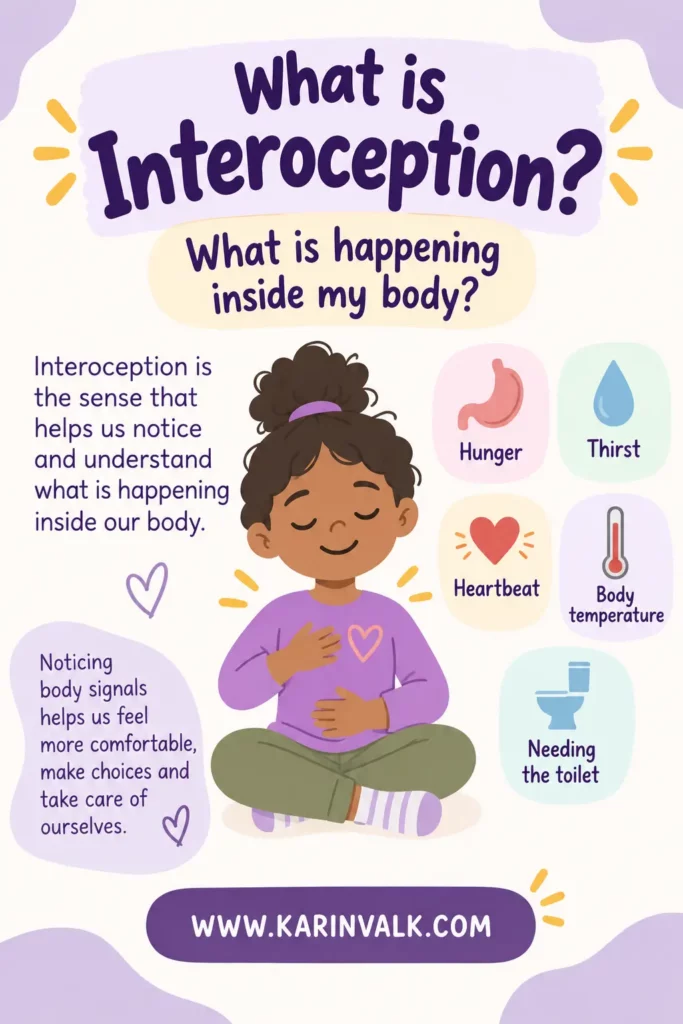
So what is interoception? In short, it’s your sense of what’s happening inside your body, and it’s often called the 8th sense. For example, it’s how you notice a growling stomach, a racing heart, a full bladder, a dry throat, or that flutter of nerves right before you speak up.
In fact, STAR Institute calls interoception “the eighth, often neglected” sensory system, which feels about right for a sense most of us never knew we had.
Interoception and Emotions
Now, these inside signals do far more than flag hunger or thirst. They’re also the raw material of our emotions. Think of a tight chest, a warm face, a heavy tiredness behind the eyes, or a stomach doing somersaults. Often, the body registers a feeling first, and only then does the mind put a name to it.
That’s why interoception is at the heart of emotional awareness. And that’s also why it can be so hard for kids who feel a lot but can’t yet find the words. Multilingual children, in particular, know this double bind well.
So what happens when interoception is less reliable? Well, a child might not notice they’re hungry until they melt down. Or they miss the urge to use the toilet, forget to drink all day, feel too hot without doing anything about it, or struggle to tell nervous from excited.
It’s easy to read some of that as misbehavior, which can be very frustrating for these kids, not knowing what’s going on. Since their body is sending faint signals, and the message keeps getting lost in the mail.
Their body is sending faint signals, and the message keeps getting lost in the mail.
Interoception vs Proprioception: What’s the Difference?
So what’s the difference between interoception and proprioception? Put simply, proprioception tracks your body’s position and movement, while interoception tracks what’s happening inside: hunger, heartbeat, temperature, and emotion.
In other words, proprioception vs interoception comes down to one thing: where the signal starts, in your muscles and joints, or in your inner organs.
Here’s the side-by-side, so you can see them at a glance.
|
Proprioception |
Interoception |
|
|---|---|---|
|
What it senses |
Where your body is and how it’s moving |
What’s happening inside your body |
|
In plain terms |
The “position and movement” sense |
The “inside signals” sense |
|
Everyday example |
Climbing stairs without looking down |
Noticing you’re hungry or need the toilet |
|
When it’s off |
Bumping into things, using too much force |
Missing hunger cues, big feelings out of nowhere |
Now, you might spot some overlap, and that’s completely normal. After all, both are internal senses. Even the science blurs a little here. The receptors have similar names, which is exactly why the “difference between proprioceptors and interoceptors” trips people up.
So, to keep it simple: proprioceptors sit in your muscles and joints, while interoceptors sit in your organs and tissues. Same idea, different address.
Sometimes, the easiest way to tell the two apart is to ask one question: Is the body reporting from the outside frame, or from the inside? Once you have that, the rest tends to fall into place.
How Interoception and Proprioception Work Together
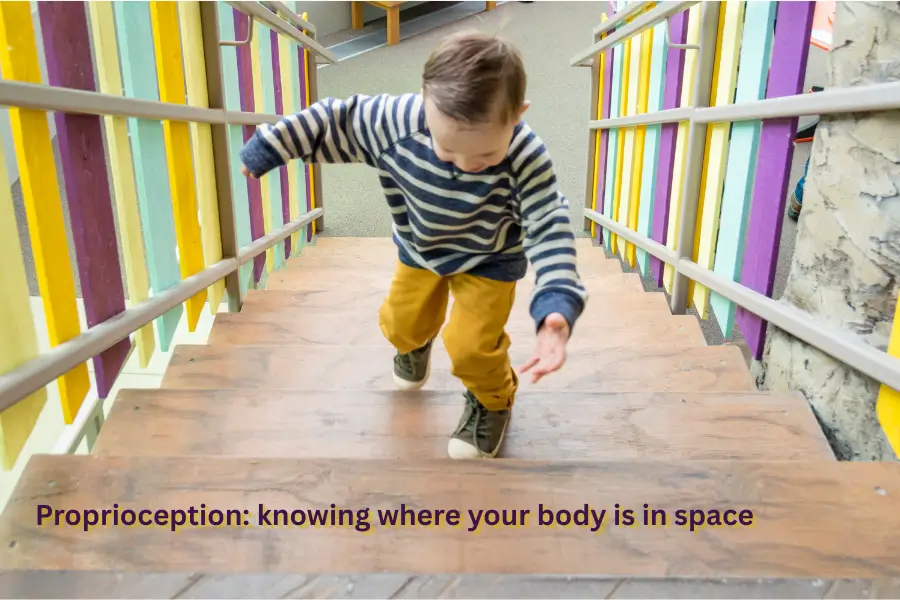
So how do interoception and proprioception work together? Most of the time, they team up without any fuss. For example, picture a child running around the playground. Their legs feel tired and heavy (that’s proprioception), while their heart pounds and their breath comes fast (that’s interoception). Together, those signals tell the child one clear thing: time for a break.
The two senses even share some of the same wiring in the brain. Because of that overlap, proprioception and interoception often grow side by side. In fact, many kids need a good dose of movement and body input before they can tune in to the fainter signals inside.
So proprioception often comes first, and interoception builds on top of it. That’s also why, in my coaching and in classrooms, we tend to start with the body before we ask about feelings.
How Stress Affects Interoception and Proprioception
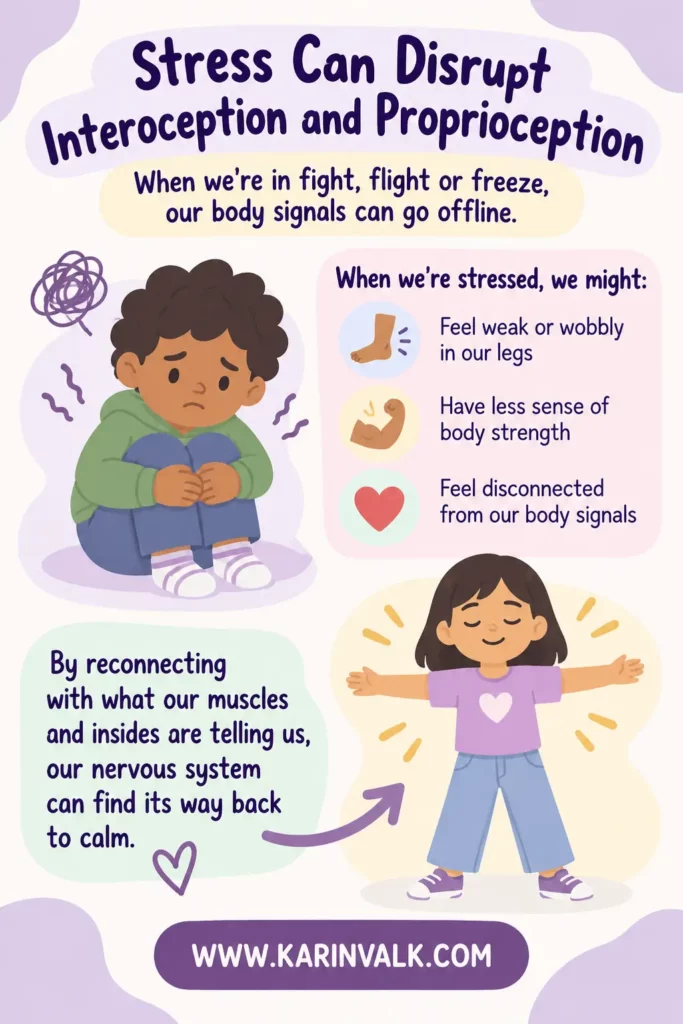
Stress can knock both interoception and proprioception offline, especially when we’re stuck in a fight, flight, or freeze response. Personally, I’ve felt this myself. During a rough patch when I was stressed and disconnected, I could stomp my feet and still feel almost no strength in my legs. They didn’t feel solid, like they weren’t quite mine. Only later, once I’d built a stronger sense of who I was and learned to take up space, did that leg strength and awareness come back.
Trauma researchers describe this too. Peter Levine and colleagues built an approach around reconnecting to what the muscles and the insides are telling us. This way, the nervous system can find its way back to calm.
In simple terms: when we’re overwhelmed, the body’s sense of itself fades, and rebuilding that felt sense is part of how we come back to ourselves.
This is the foundation of my coaching, too. As an embodiment coach, I help people build a strong, clear sense of who they are, so they can take up space and feel more at home in their own body. It’s also why the specific training program, Boys in Their Strength & Power, starts exactly where this section did: with feeling and body awareness, and leg awareness in particular. If that speaks to you, you can read more about how I work here.
What Causes Proprioception and Interoception Problems?
So what causes proprioception problems, and interoception ones too? Often, it comes down to differences in how the brain processes sensory information. For some people, the inner signals simply arrive faint, mixed up, muffled, or all at once.
This shows up a lot in autistic kids, kids with ADHD, anxious kids, and plenty of adults, though it can happen to anyone. It isn’t a fault or a failure. Their sensory wiring is just tuned differently.
And yes, a child can absolutely have both proprioception and interoception difficulties at the same time. In fact, the two often travel together. A child who can’t feel where their body is may also struggle to notice hunger, thirst, tiredness, or a full bladder.
That’s a lot to manage at once, so meltdowns and shutdowns make sense in that light.
Stress plays a role as well. As we saw earlier, both senses can dim under pressure. So a child having a hard week, or dealing with a big change, may temporarily lose some of the body awareness they usually have.
Interoception and Proprioception in Autism and ADHD
Interoception and proprioception in autism and ADHD often work a little differently, and that’s well documented. Many autistic kids feel internal signals as too faint, too strong, too similar, or too hard to tell apart.
Lots of kids with ADHD, meanwhile, are so busy moving or daydreaming that the fainter inner cues get drowned out.
None of this means something is wrong with the child. It means their body speaks a slightly different language, and they may need more time, more movement, more repetition, or clearer cues to understand it. Once the adults around them get that, so much tension eases.
So what actually helps? One low-effort place to start is deep pressure. A weighted lap pad rests across the legs and adds a calm, even weight. This can take the edge off when both senses feel like too much. I keep a weighted blanket on my own bed, so I can vouch for how calming that deep pressure is.
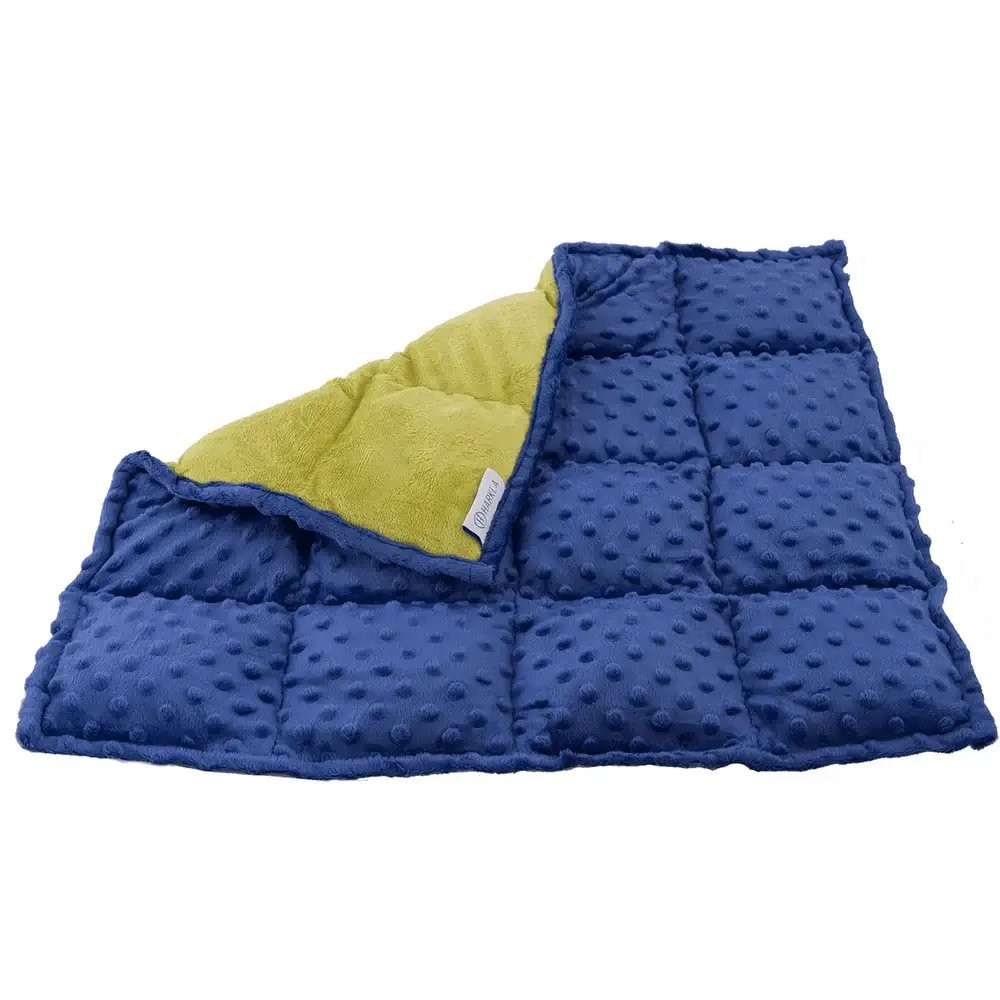
Harkla Weighted Lap Pad
A calming tool when overwhelmed by both senses. The deep pressure delivers proprioceptive input (a clear signal of where the body is), while the soft minky dots give them something to trace, drawing attention back inside.
Want to compare a few weighted lap pads before you choose? My full guide to the best weighted lap pads breaks down 8 picks for kids, adults, autism, and ADHD.
Related post: 8 Best Weighted Lap Pads to Tackle Anxiety
FAQ: Interoception vs Proprioception
Yes, proprioception is one of your eight senses. It’s the sense of where your body is and how it’s moving. It works in the background every time you walk, reach, or sit down. It’s also one of the three hidden senses most of us were never taught, which is exactly what this post unpacks.
Yes, interoception is a sense too, and it’s often called the 8th sense. It’s how you notice what’s happening inside your body, from hunger and thirst to a racing heart or a wave of emotion. It’s easy to mix up with proprioception, which is exactly what the comparison above is for.
Proprioception is handled mainly by the somatosensory cortex and the cerebellum, which process signals from receptors in your muscles and joints. Together, they keep a constant map of where your body is. Interestingly, some of that wiring overlaps with your inside senses (interoception), as the comparison above explains.
Proprioception tells you where your body is and how it’s moving, while your vestibular sense tracks balance and the position of your head. Both are hidden senses that work without your input. Vestibular is the third hidden sense we only touched on here, and it is getting a post on its own.
The three hidden senses are proprioception, interoception, and vestibular. In short, proprioception covers body position, interoception covers the signals inside, and vestibular covers balance. You’ll find each one explained in plain language earlier in this post.
Final Thoughts on Interoception vs Proprioception
Once you know interoception vs proprioception, a lot of everyday behavior makes more sense. They’re two of the 8 senses of the body, and together with the vestibular sense they shape how a child (or an adult) feels, moves, reacts, and copes. So the next time a kid can’t sit still, or can’t tell they’re hungry, you’ll know there’s a body reason underneath.
Ready to put this into practice? My post on interoception activities for kids gives you simple, hands-on ways to build these skills at home or in the classroom.






2 Comments