You’ve googled “what to pack for a flight with kids” at 11pm, opened fourteen tabs, and still weren’t sure. Here’s the thing: a good airplane activity kit for kids isn’t about keeping them quiet (although that can be a bonus). It’s about giving them what they need to feel okay in a loud, cramped, pressurised environment that is challenging for most nervous systems. (Adults included. We just have better coping mechanisms. Sometimes.)
I earn commissions when you shop through the links below at no additional cost to you. As an Amazon Associate I earn from qualifying purchases.
I sometimes include Amazon links because I know ease and accessibility matter—especially for busy parents and teachers—but I’m also working on adding more options from smaller or values-aligned businesses. I’ll keep updating this post as those become available.
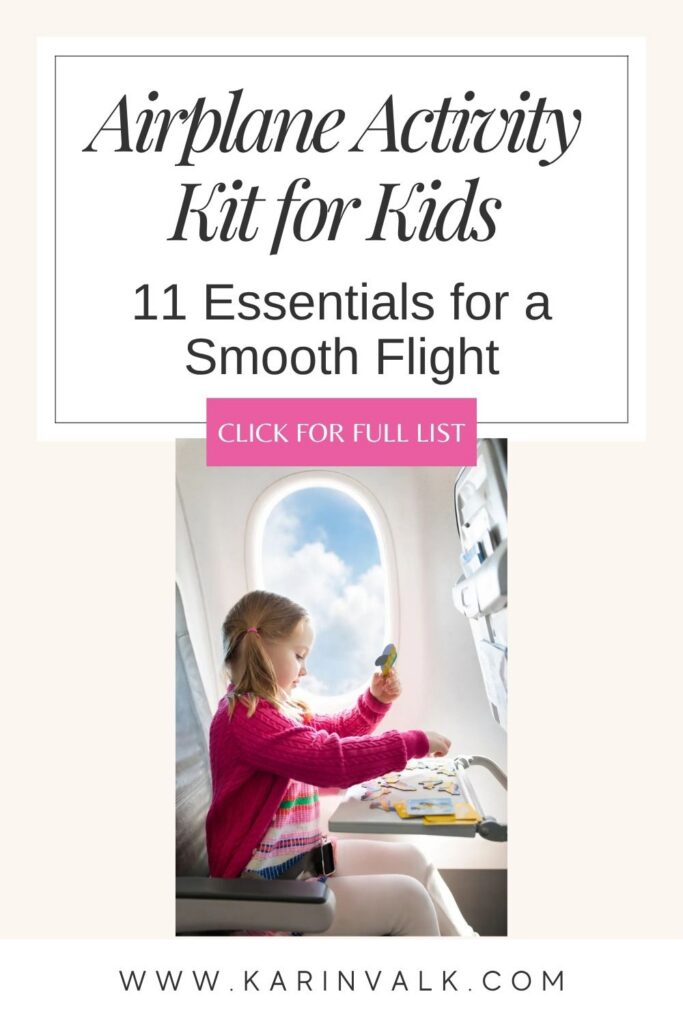
This post is about 11 airplane travel essentials picked with one question in mind: does this help a child feel genuinely supported, or does it just keep them quiet? As an embodiment coach and former international school teacher, I look at these things through a nervous system lens. What helps a child stay regulated when they’re overwhelmed, and what just buys you ten minutes before the next meltdown?
You’ll also find: what to pack for a flight without the fourteen-tab spiral, how to pack your airplane activity kit for kids so the last hour of the flight feels as manageable as the first, the best toys for airplane travel for every age from toddlers to tweens, and how to help a sensory-sensitive or easily overwhelmed child stay calm when everything around them is doing its best to tip them over.
This post is all about easily creating an airplane activity kit for kids.
If you’re raising globally mobile children or third culture kids, you’ll know that flights often come loaded with more emotion than a standard holiday trip. This post helps you understand and support this experience:
What Should Be in an Airplane Activity Kit for Kids?
Besides novelty, novelty, novelty (a proven strategy to keep kids engaged and focused for long periods of time), a good airplane activity kit for kids covers four things:
- something to create with,
- something to fidget or focus with,
- something to listen to,
- and something to eat.
This works whether you’re on a two-hour hop or a full transatlantic haul.
Before we get into the list though, what to pack for a flight is really a question of what helps your child feel okay in that environment, not just what keeps them occupied. Kids on flights are managing a lot: unfamiliar sounds, pressure changes, disrupted routines, unfamiliar faces and places, and a body that can’t move the way it wants to.
The airplane travel essentials that do their job are the ones that meet those needs.
The 11 items below cover mess-free creative play, sensory regulation tools, calm-down aids, screen-free audio, and snacks. They’re all compact enough to fit in a carry-on alongside your other airport bag essentials, and easy enough for kids to use independently mid-flight.
If you’ve been looking for ideas for kids activities on an airplane that go a little deeper than a screen and a prayer…this is that list!
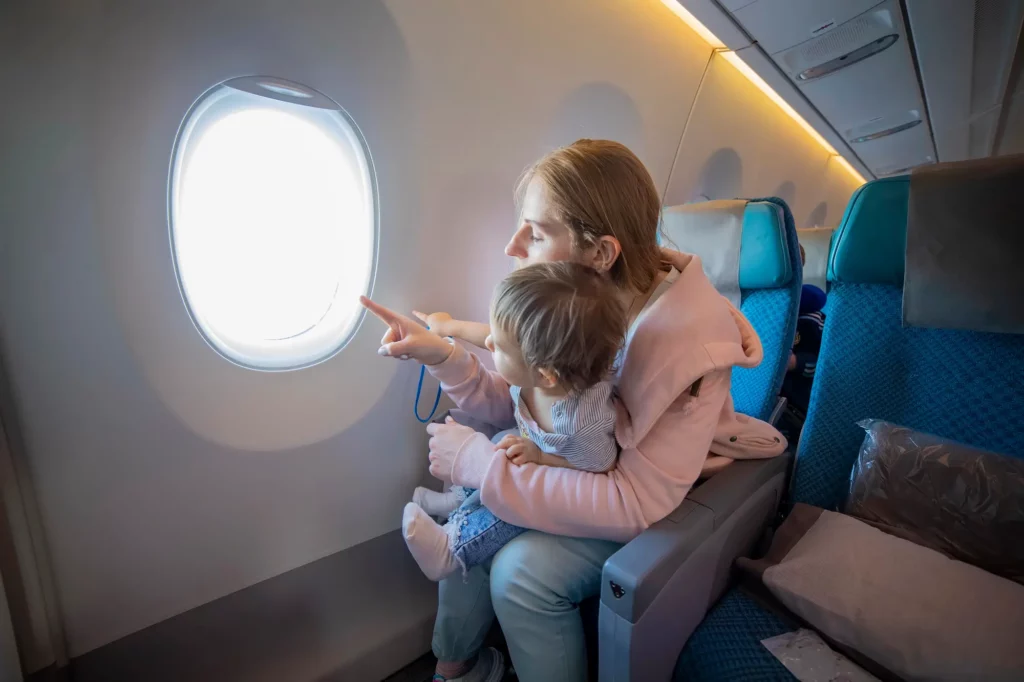
The 11 Airplane Activity Kit Essentials
These are the 11 items I’d put in any kids’ airplane activity kit. Chosen because they travel well, hold attention for way more than five minutes, and do something genuinely useful for a child’s nervous system rather than just filling time.
A few are among the best travel toys for kids you’ll find on Amazon; one comes from a specialty sensory retailer that really knows their stuff.
1. Water WOW Airplane Activity Pad
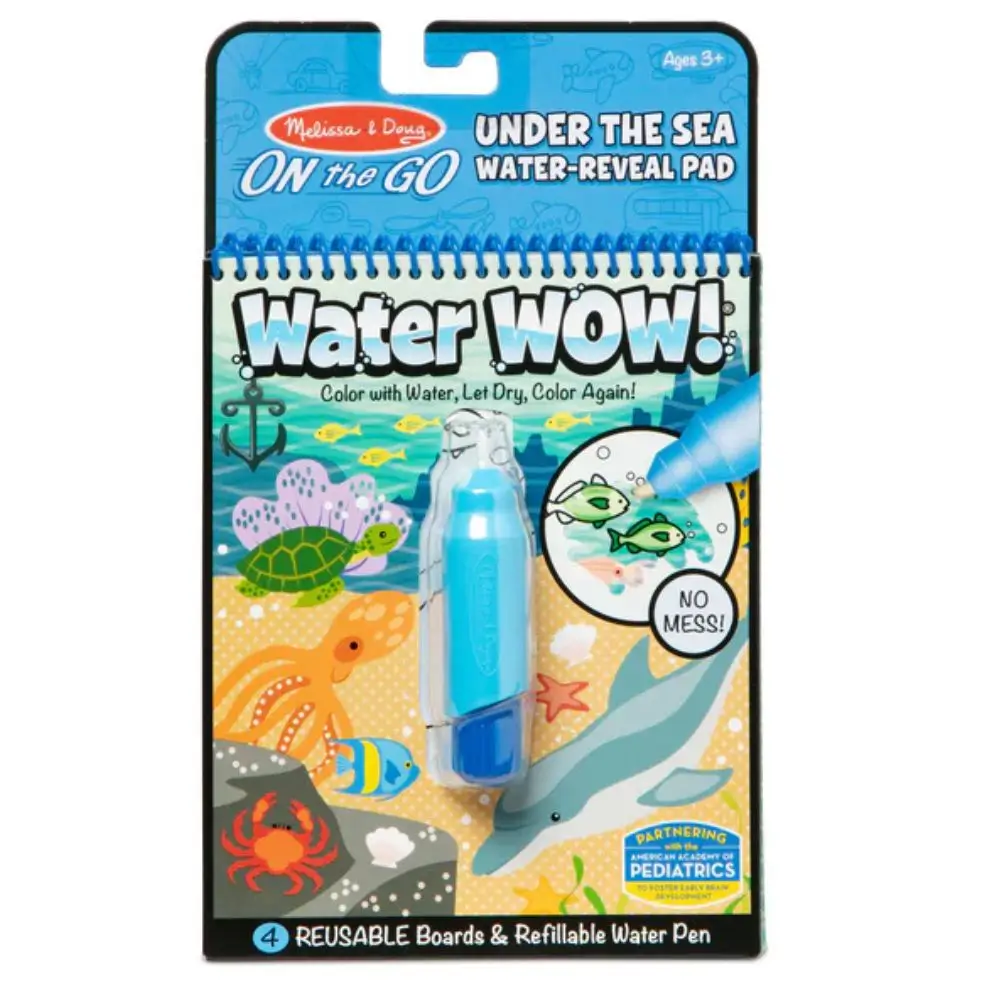
The water wow airplane activity pad is one of those products that does exactly what it promises and nothing more. Which, in a cramped airplane seat, is exactly what you want. Your child fills the chunky pen with water, brushes it across the page, and colours appear. When the page dries (usually within 5–10 minutes), it resets completely and they start again.
Think of it as a reusable water activity pad kids reset and reuse, perfectly sized for a tray table. The slow, repetitive brushing motion has a naturally calming quality to it. And parents consistently report 30 minutes or more of focused engagement (!) which sounds like science fiction at 35,000 feet but is genuinely what reviewers describe.
It’s a mess-free coloring book for the plane in the truest sense: no crayons rolling under the seat, no ink anywhere it shouldn’t be, and the water pen clips into the spine so nothing gets lost mid-flight.
One honest note: the pen can occasionally leak, so a small cloth or zip-lock bag tucked alongside is worth it.
Good for ages 3 and up, available in a variety of themes.
2. Reusable Sticker Book Airplane
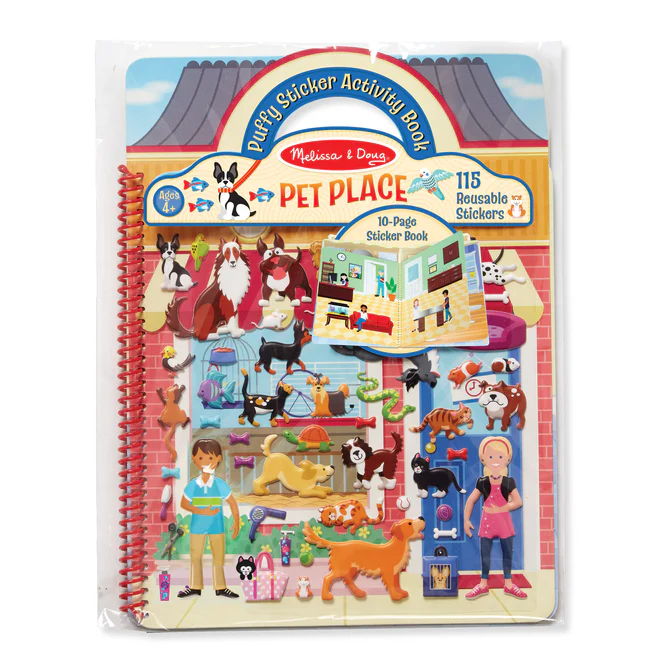
The reusable sticker book airplane activity earns its place through one simple fact: kids will use it independently, for a long time, without needing you. The puffy sticker activity travel books from Melissa & Doug come with themed scenes (e.g., pets, safari, dress-up) and a set of thick, raised stickers that press onto the page, lift back off, and go somewhere completely different when your child changes their mind. Which they will. Multiple times. That’s the point.
The thick, tactile quality of the stickers gives little fingers something satisfying to work with. Easier to peel and place than regular stickers, which is important since fine motor frustration is nobody’s friend on a crammed airplane.
Parents report an hour or more of independent play, with kids rearranging scenes and narrating stories to themselves. It’s a no mess sticker book for kids on a flight…literally. Nothing migrates to unwanted places like the back of the seat, your sleeve, or the stranger next to you.
Good for ages 4 and up, available in a range of themes.
3. LCD Writing Tablet Airplane
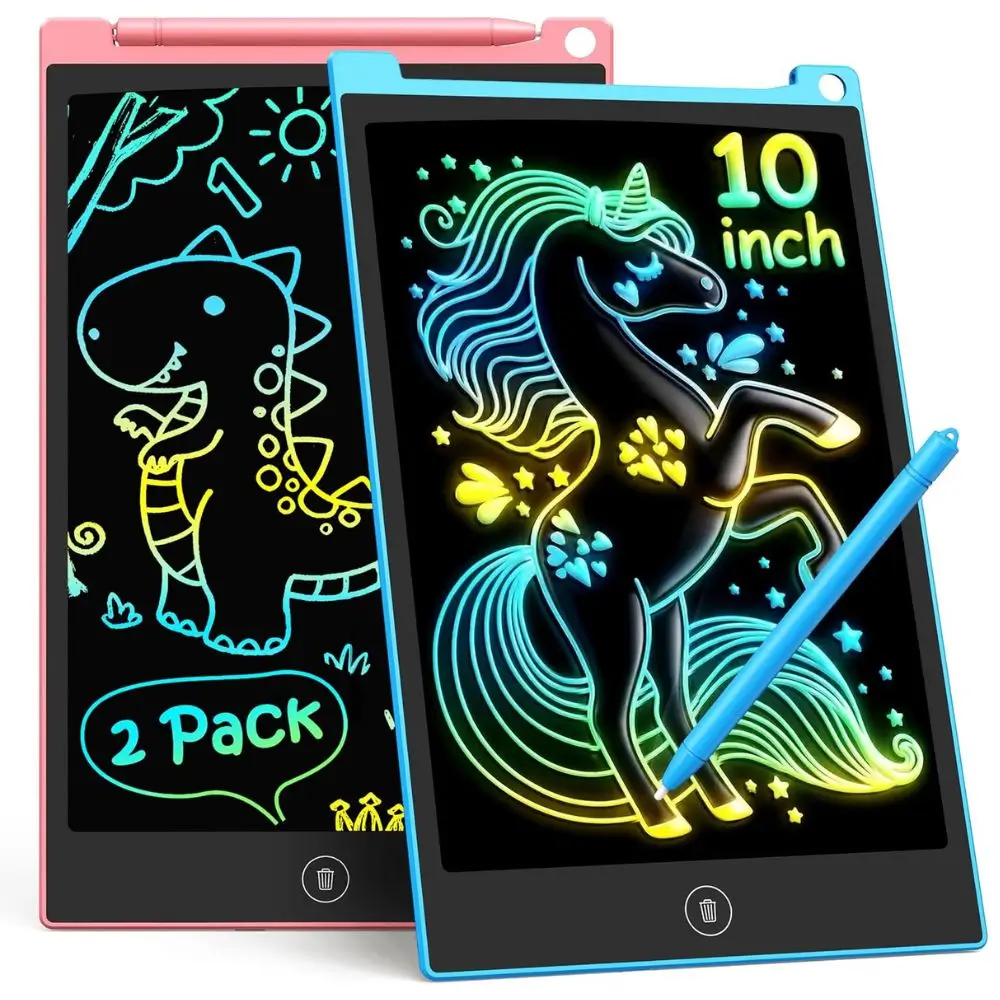
The lcd writing tablet for airplane travel is THE doodle board for kids on the go. It weighs almost nothing, fits on a tray table, and erases with one button press. Your child draws, writes, scribbles something abstract, decides they hate it, wipes it, and starts again. Repeat for the duration of the flight (or for at least a little while, lol).
What makes it particularly good for a nervous system under pressure due to all the travel stimuli: drawing and doodling are genuinely regulating activities. The physical act of mark-making (in this case, moving a stylus across a surface) gives hands something purposeful to do without requiring much mental effort.
It’s an accessible, open-ended activity that keeps a child relaxed without them realising it. Parents consistently describe it as their silent lifesaver on long journeys: no mess, no sound, nothing to retrieve from under the seat when it rolls away (because it won’t.)
The reusable drawing tablet for the plane can also function as a spot to practise letters or numbers for children in that phase. Bonus!
Ages 3 and up.
4. Wipe Clean Activity Book Plane

A wipe clean activity book for the plane serves a slightly different purpose than the LCD tablet, and so I’ve included them both. Where the doodle board encourages free expression, this one gives structure: mazes to solve, lines to trace, dots to connect, pictures to finish.
For kids who find open-ended activities a bit directionless, structured tasks with a clear beginning and end are often more calming.
The Highlights Write-On Wipe-Off range has been a bestselling travel puzzle book kids come back to for years. 187,000 copies sold in two years, and consistently ranking in the top handful of children’s books on Amazon overall. It comes with a dry-erase marker, wipes clean after each use, and covers activities that increase in difficulty, so it works from age three to seven.
It’s great as an airplane activity workbook because the tracing, letter, and number versions give it an educational layer that older toddlers and preschoolers especially enjoy. A child working through a maze or tracing their letters has their hands occupied, their attention focused, and far less capacity left over for the kind of restlessness that turns an otherwise calm, long flight into a memorable experience.
5. Magnetic Travel Game Airplane

The magnetic travel game for an airplane is a travel favorite! Open the tin, hand it to your child, and the next hour or so largely takes care of itself. Mudpuppy’s magnetic play sets come in a sturdy tin that is used as both the play surface and the storage box. Smart!
The sets include 45+ mix-and-match magnets across themed scenes (veterinarians, food trucks, hair styling, camping, whatever your child is currently into). Great options for imaginative play, which has many benefits for children’s development.
There’s no right way to arrange a magnetic toy for plane rides, which is exactly what makes it fun for a long time. One parent reported their 3.5-year-old played with this throughout a transatlantic flight and kept going for days afterwards. If that’s not genuinely engaging, then I don’t know what is!
One honest note: the magnets are small, so a quick sweep of the tray table before putting it up is worth it. It’s a no mess game for kids on a flight in almost every sense…except possibly the “keeping track of 40 tiny pieces” sense. A small zip-lock bag tucked inside the tin can help with that!
Ages 4 and up.
6. Card Game for Kids Airplane
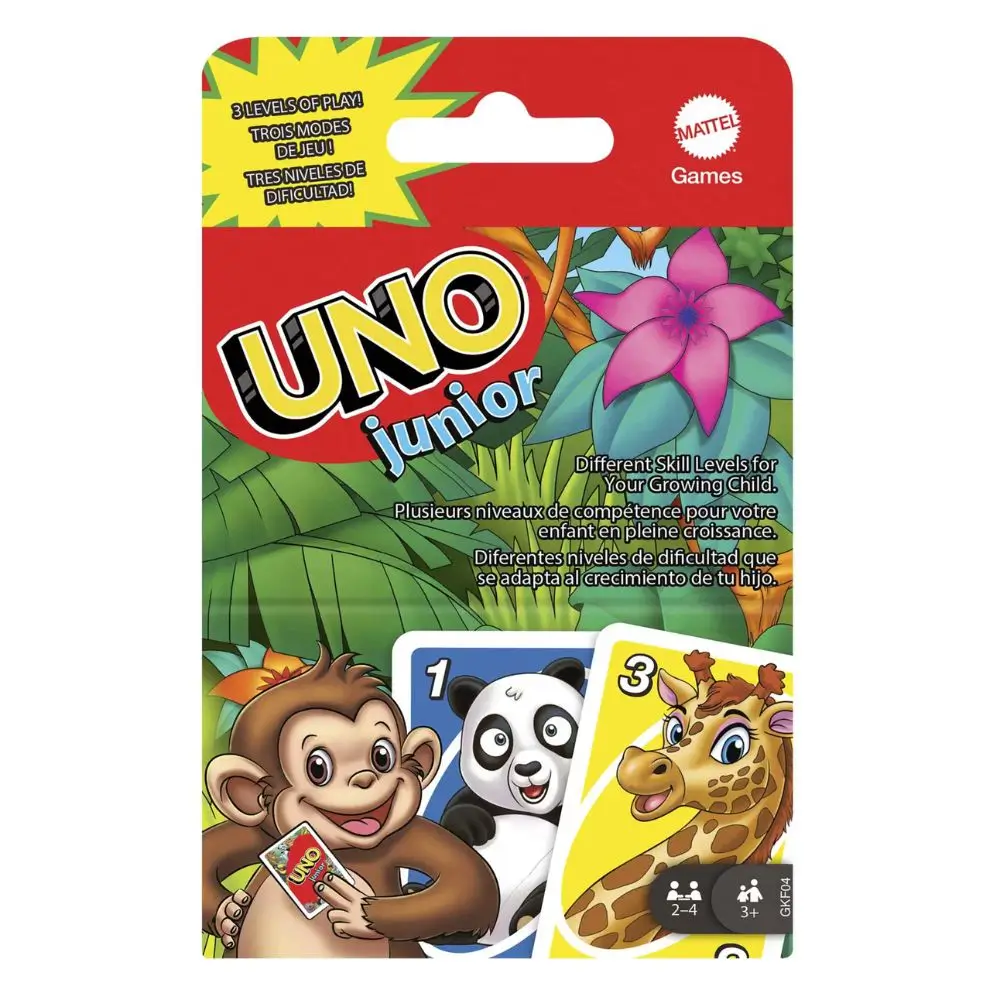
The card game for kids on an airplane that is an absolute classic. UNO Junior is the one item in this kit you play together. A child engaged in a game with you is a connected child. Co-regulation is one of the most effective nervous system regulators.
Each number card has a matching animal illustration, so children who don’t yet know their numbers can play by matching animals. Three different levels keep it interesting as they get older: start with simple matching, add action cards when they’re ready, and eventually add penalty cards.
It’s an easy travel card game kids generally pick up fast. And the card-play itself is quiet enough for a plane. Fair warning though: when your child is about to win, they will tell you. Likely at volume (a quiet card game for the plane in theory, not necessarily in spirit!).
Unless they’re playing with siblings, this one needs you present and engaged, so save it for when you’re up for connection rather than the stretch where you’re hoping for some quiet time.
There are a variety of versions, including this fun Pixar-themed one.
Ages 3 and up, 2–4 players.
If you are interested in co-regulation strategies to deal with big emotions, you’ll find this helpful:
7. Quiet Fidget for Airplane
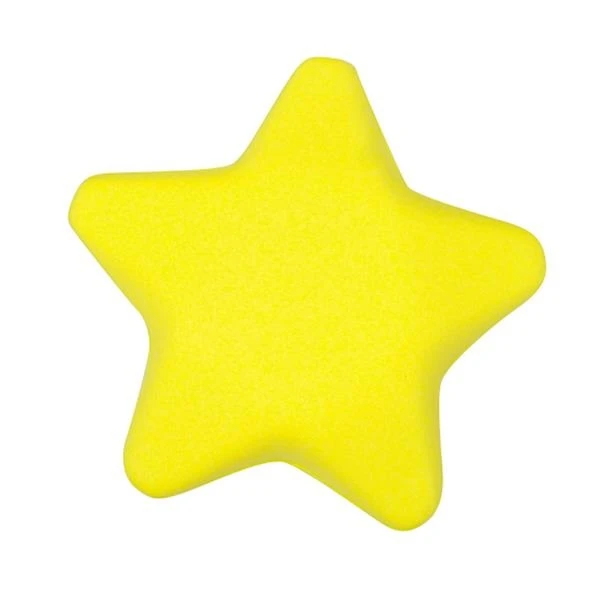
A quiet fidget for the airplane sounds like a nice, but not so necessary item, until you’re at hour three and your child cannot stop wriggling, poking, touching everything in reach, and slowly (or not so slowly) becoming disregulated. This is where the Squeeze Star saves the day!
Squeezing provides proprioceptive input (pressure-based sensory feedback to the muscles and joints) which has a genuinely calming and organising effect on the nervous system. The Squeeze Star is a silent sensory toy for travel: soft enough to be satisfying to touch, compact enough for a pocket, and shaped in a way that makes it more interesting than a standard stress ball.
Hands with something purposeful to do are hands that aren’t seeking stimulation everywhere else.
It’s a particularly effective calming fidget for kids mid-flight because it works for any child who has had enough of sitting still. Not only kids with diagnosed sensory needs, but most children past the first hour of a flight. Pair it with the headphones or the breathing cards that follow next in this list, and the regulation effect compounds.
It can also be great for taking off and landing, as the tray table can be stowed, and they have something to focus on if they’re nervous.
Available at National Autism Resources, a specialist retailer for sensory-friendly products.
Whether traveling or meeting daily needs for kids that need more sensory support, this related post has a great list:
Related post: 17 Excellent Sensory Toys for Autism That Help All Kids
8. Calming Headphones for Airplane Kids. THE must-have for an airplane activity kit for kids

Noise reduction headphones kids travel comfortably with are hard to find. Most kids headphones either lack real sound blocking or run out of battery before you’ve hit cruising altitude. The iClever BTH20 headphones solve both. They deliver 40dB of active noise cancellation, which takes the edge off engine roar and cabin noise, and a certified 80dBA volume cap that protects young ears even when kids try to turn them up.
Battery life is 35 hours with ANC on, 60 hours without. Perfect for long travels! That is if you charge it before you leave 🙂
These are headphones for sound sensitive child flight situations too (is that a sentence? I need coffee). The over-ear cushions create a physical sound barrier before the ANC (active noise cancellation) even kicks in, which can make a real difference for kids who find airplane noise overwhelming.
I’m sensitive to sounds myself, and I can tell you over-ear headphones are a welcome improvement compared to earphones.
The adjustable headband fits ages 3 and up, and the foldable design helps to pack without taking up too much space. Or carry it around the neck, why not. Parents consistently note that their kids don’t fight wearing these, which is maybe the most important thing to know.
9. Breathing Cards for Kids Travel
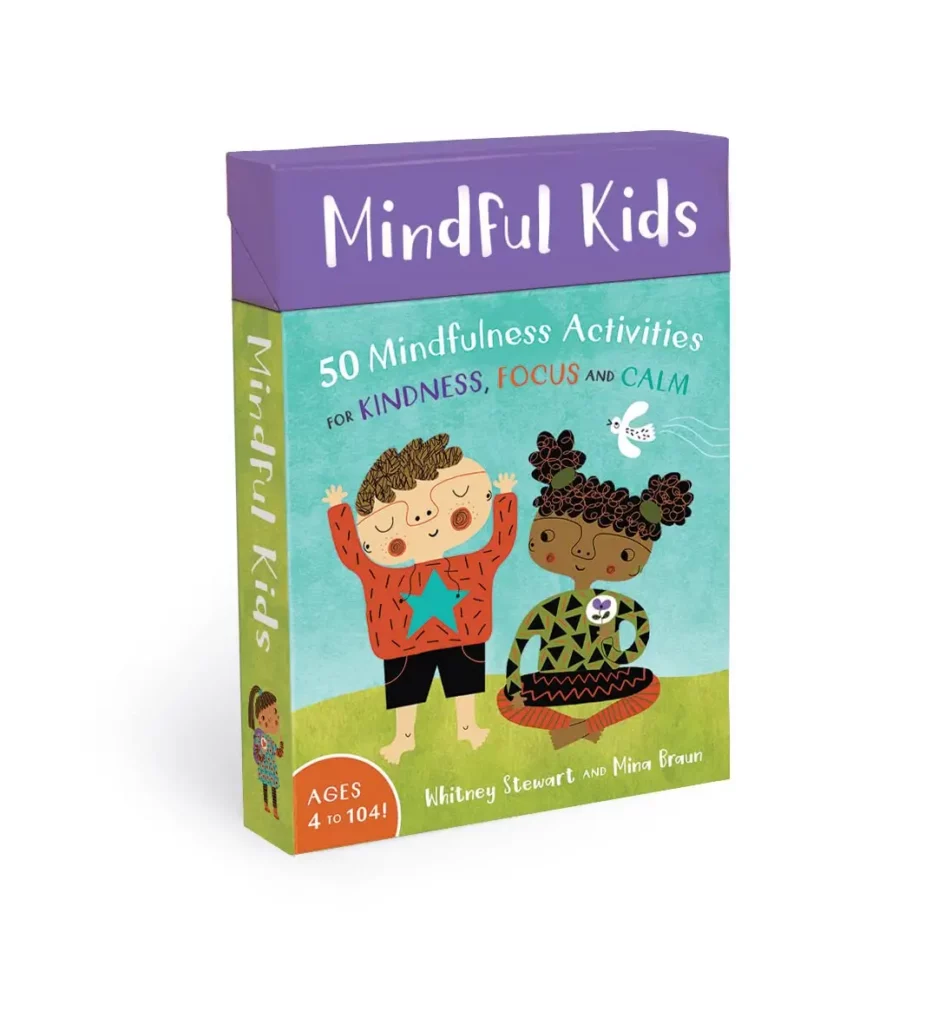
Breathing cards for kids are easy to travel with! They’re lightweight, flat, and don’t need batteries, Wi-Fi, or a clean tray table.
The Mindful Kids deck by Whitney Stewart (Barefoot Books) has 50 illustrated activity cards across five categories:
- finding calm,
- building focus,
- grounding,
- loving-kindness,
- and deep relaxation.
Each card has simple steps to follow and images that make these visual. When you practice these at home, even a four-year-old can follow along without a parent reading the words aloud.
Where many calm down cards that parents pack are single-technique (e.g. just box breathing, just counting) this deck gives you options. If deep breathing isn’t working, you flip to a body-awareness card. If a child is wound up rather than anxious, the focus cards might help better with that energy.
Parents who teach mindfulness or work in therapy regularly mention how sturdy and intuitive the cards are, no lamination needed.
Because there are so many to choose from, they make great activities for kids on a plane. They can be used during boarding chaos just as well as on descent when ears are popping and patience is thin.
Make sure to filter out which cards will be useful and which are impractical so you’ve got the right ones on hand immediately.
10. Snack Box Airplane Kids

The right snack box for a flight is one your little one can open independently, without spilling or tray table disasters. The Bentgo Kids container has two compartments with a single easy-latch lid that children manage from around age three.
Crackers on one side, fruit on the other, and the leak-proof seal means it’s great as a travel snack container kids can carry in their own backpack!
Snacks are one of those airplane travel essentials that parents often underprepare. Too few and you’re rationing and dealing with hangry kids. Too many loose in a bag and you’re fishing for raisins under the seat. A contained, portioned box avoids discussions: the box is what’s available, and when it’s done, it’s done (so make sure it’s filled for long flights!).
For airplane snacks for toddlers especially, the two-compartment layout is ideal for small portions of different textures (something crunchy, something soft, etc.) which helps to support sensory engagement. BPA-free, dishwasher safe.
11. Screen Free Audio Player Airplane

The Toniebox is the screen free audio player airplane bags have been missing! This is why it needs to be added immediately: Small character figures called Tonies sit on top of the box to trigger stories, songs, and audiobooks. Children swap them out themselves, which means they’re entertained and independent without a single screen in sight.
As a story box kids travel with repeatedly, it’s one of the best toys for airplane travel precisely because there’s nothing to tap or swipe.
It runs for hours on a single charge, the volume knob is child-sized, and as a calm travel toy without screens it truly delivers: parents consistently describe long-haul flights where their child listened contentedly for over an hour. Winning! One of those great and unique options when you want to keep kids entertained on a plane without screens.
It comes in many different bundles, but my nephews LOVE paw patrol so that’s what made it on the page. Definitely browse the options here.
How to Pack an Airplane Activity Pack for Kids on a Long Flight
Packing an airplane activity pack for kids well is not just about what you include, but also when you reveal it. A useful trick you can try is one of those airplane hacks for kids that sounds too simple but works, is to keep everything hidden and introduce one item every 30 to 45 minutes.
Research on child engagement consistently shows that novelty (seeing something new) is one of the strongest drivers of focused attention in children.
The rotation strategy works because it creates novelty deliberately, turning one airplane activity pack for kids into what feels like a series of small surprises. Fun!
When thinking about what to pack for a plane ride, divide your travel activity pack for kids into three rough rounds:
- something creative for the first hour when energy is likely high,
- something quieter or calming for the middle stretch when they get tired,
- and your strongest item (e.g. new book, Toniebox, favorite fidget) for when it’s most needed.
Ok, and SNACKS. But that goes for the adults too.
A few travel kit essentials worth remembering: keep the pack within arm’s reach so you’re not standing in the aisle each time. Resist pulling things out just to fill silence. Boredom is not an emergency.

Helping Kids Stay Calm and Regulated on the Plane
A child who is struggling on a plane is not being difficult or defiant. They’re in a loud, pressurised, unfamiliar tube with no room to move and no way out, lots of strangers, and you name it. Their nervous system is doing exactly what it’s supposed to do: giving off signals they need something.
The best plane activities and the best travel toys for kids in the world won’t override that if the environment itself feels unsafe to their body.
What helps is addressing the environment directly. Easy airplane activities for kids work best when they’re paired with something physical first: movement before boarding, heavy pressure through a hug or even a tight seatbelt, noise reduction where possible. The items in this list were chosen specifically as plane activities for kids who need more than distraction. They need genuine regulation support, so let’s make sure they get it.
And the most powerful tool on any flight isn’t something you can pack. It’s you. Your nervous system is the one your child’s borrows from when theirs is overwhelmed. They need your co-regulation. Good thing you’re there!
Frequently Asked Questions About Traveling With Kids
Here are the questions parents ask most: from building the right kids airplane activity kit and finding screen-free things to do on a plane, to packing by age and supporting a sensitive or easily overwhelmed child on a flight.
The best airplane activity kit for kids combines mess-free creative play, sensory tools, and screen-free audio in a travel bag children can access independently. This list with 11 travel essentials for kids covers all three.
For a DIY airplane activity kit for kids, choose 4–5 items matching your child’s age and sensory preferences; the most personalised approach to things to pack for a trip. For ready-made travel kit ideas, the full 11-item list works as a complete guide. Quick and easy!
The best things to do on a plane for kids without screens are hands-on and support sensory needs (which we all have to a greater or lesser extent). Fun airplane activities for children like drawing tablets, sticker books or card games, are the most reliable ideas for kids activities on airplane because they need no adult setup once underway.
For airplane activities for kids that hold attention longest, open-ended and new toys are most effective. Kid travel activities and games to play on airplane work best with simple rules; the simpler, the longer the engagement.
The best travel games for kids are compact, quiet, mess-free and not easy to lose around the seat. When deciding what to pack for a flight, look for toys for plane travel with no loose pieces (unless they’re like the magnets game mentioned in this list, which works great!).
Toys for kids on airplane trips work best when they need no surface prep. For more airplane ideas for kids, this full list covers every age and sensory need (mainly younger kids though, as they just need more guidance and regulation). One of the simplest plane hacks for kids: keep items in a small separate pouch or their own travel activity kit, so nothing needs unpacking mid-flight. Good travel bag ideas for kids start with the preparation!
For flying with toddlers (1–3), toddler travel essentials are the Water WOW, sticker book, snack box, and Toniebox. That’s already a pretty complete airplane activity kit for toddlers right there. For airplane activities for preschoolers, add the LCD tablet and magnetic set.
Airplane activities for 5 year olds and up call for more strategy (although the previous ones can still be great options): card games and wipe-clean books are popular.
For airplane activities for 10, 11, and 12 year olds, audio and fidget tools support focus and regulation. Teen travel essentials lean the same way. If they are readers, definitely bring favorite books for travel! And make sure they download Spotify music lists or podcasts before losing internet connection.
Snacks to eat during take-off and right before and during landing to prevent the painful ear thing is definitely helpful! Take it from me…I’ve got sensitive ears, and people told me to only do it before landing and it HURT. To be sure, chew chew chew on stuff during all these three phases of the flight.
If you forget, ask your flight attendant, they’ve got something for it.
Start before you board. Movement, a snack, and noise reduction where possible (headphones for the win!) help a child whose nervous system is already working hard in an unfamiliar environment. Mid-flight, the tools that make the biggest difference are sensory ones: the headphones, the Squeeze Star fidget, the breathing cards which you can find in this list.
If you forget to pack things, let this be reassuring: the most powerful regulation tool isn’t in any travel bag. A dysregulated child borrows calm from trusted adults. Your calm and presence is THE thing to feel supported. You’ve got this!