When a sense of belonging is missing it can feel like something essential is absent (and it is!). For many people, especially those who’ve moved across countries and cultures, belonging can start to feel like a nice idea rather than a lived experience.
This post shares research-backed ways to build a sense of belonging in real, doable ways. Even when “home” feels unclear or far away.
I earn commissions when you shop through the links below at no additional cost to you. As an Amazon Associate I earn from qualifying purchases.
I sometimes include Amazon links because I know ease and accessibility matter—especially for busy parents and teachers—but I’m also working on adding more options from smaller or values-aligned businesses. I’ll keep updating this post as those become available.
If you’ve ever struggled to explain what feels missing when a sense of belonging isn’t there, join the club. For people who move between countries, cultures, schools, or communities, belonging can start to feel vague or out of reach, like something other people seem to have figured out. It’s not just about having friends or fitting in. It’s about feeling safe enough to be yourself, and knowing that you matter where you are.
This topic is deeply personal to me, and it’s one I see come up again and again in globally mobile lives. Over time, certain practices and insights have made a real difference. They’ve made it more accessible and a lived experience. I want you to feel that too!
You’ll find nine practical, research-backed ways to create a sense of belonging anywhere, with examples that reflect internationally mobile and cross-cultural lives. Because we all deserve to know that feeling of belonging!
This post is all about a sense of belonging.
9 Ways to Create a Sense of Belonging Anywhere
If you’re here because a sense of belonging feels far away, I want you to know this: you don’t have to figure it out alone. These are practical, research-backed ways to create a sense of belonging step by step, especially when life has been cross-cultural and full of transitions.
1. Build a Sense of Belonging: Start With One Safe Relationship
Building a sense of belonging can be more practical than you might expect, with little moments of safety rather than big social breakthroughs.
Why this helps
A sense of belonging rarely comes from being part of a group right away. Research on belonging, attachment, and nervous-system safety consistently shows that people begin to feel a sense of belonging through one relationship where they feel emotionally safe.
For people who’ve lived across cultures and countries, this matters even more. When you’ve had to adapt repeatedly, your body often learns to stay alert. In that activated state, belonging doesn’t grow through the quantity of people around you. It grows through reliability.
One stable connection can start to restore a belonging feeling that feels real. The trick is to do your best to open yourself up to connecting again. And that might not be easy at all, but it is worth it.
What “one safe relationship” actually means
A safe relationship doesn’t have to be deep or emotionally vulnerable. It simply means:
- you don’t feel pressure to impress or perform
- you don’t have to explain your whole background
- your nervous system feels a little calmer when you’re with them
That person might be:
- one colleague or classmate
- one parent at school
- one neighbour
- one teacher, coach, or community member
If you’re trying to create a sense of belonging, this is often the most realistic and effective place to start.
How to do this in practice (step by step)
Step 1: Choose the lowest-effort connection.
Ask yourself: Who feels easiest to be around, even if we’re not close (yet)?
Ease is more important than shared history.
Step 2: Create a small, repeatable moment.
Belonging grows through repetition. Choose something simple:
- a short weekly walk
- standing together at the same school pick-up spot
- a regular check-in message
Consistency matters more than depth at this stage.
Step 3: Go one step beyond surface talk, not more.
You don’t need to share your life story. Try:
- “What’s been surprisingly hard/interesting about this place?”
- “What helps you feel a bit more like yourself during the week?”
These questions allow connection without overexposure. Taking it slow might help you notice sooner if your nervous system starts sounding the alarm, and this will give you time to sit with it and realize what’s going on.
This is important, so you can calm yourself before your default coping mechanism sets in and decides connections are scary and you should go focus on something else.
Step 4: Notice the body cue.
After spending time together, check in:
- Did my shoulders drop a little, or did I notice any sign of relief or relaxation?
- Was my breathing calm and in my belly, or nervous and in my chest?
Body signs that signal calm and relaxation are often the first sign that a sense of belonging is beginning to form.

If this feels hard (and that’s very common)
If you notice resistance, tension, numbness, or doubt, that’s likely your nervous system remembering the “risks” that come with building connections (since people leave frequently in these global communities – I was literally told two friends are moving as I was writing this post. Here we go again…). When there has been repeated loss or disruption, the system often protects itself by staying distant.
Starting small respects that protection instead of fighting it.
Belonging doesn’t require forcing connection. It requires conditions where connection can grow. Including being kind to ourselves and remembering we all move at our own pace.
If you are wondering what belonging actually means and feels like, you will enjoy this post:
2. Create Little Rituals That Travel With You
When people and places change around you frequently, creating a sense of belonging usually starts with restoring a feeling of continuity.

Why this helps
A sense of belonging depends heavily on predictability and safety. Research from psychology and neuroscience shows that repeated, familiar experiences help the nervous system settle, which makes connection and openness more possible.
When life feels fragmented, rituals provide structure the body can rely on.
For people living globally mobile or transitional lives, external belonging cues (place, people, language, social norms, cultural expectations, etc.) are often unstable. Small rituals help rebuild a belonging sense that doesn’t disappear every time circumstances change.
Over time, these repeated moments can create a more steady belonging feeling.
What counts as a ritual (and what doesn’t)
A ritual is not something elaborate or time-consuming. It’s simply a repeated action that signals “this is familiar”.
Helpful rituals often:
- happen at the same time or in the same way
- don’t require extra energy
- feel like they’re yours rather than something to “perform”.
Examples include:
- a consistent morning routine
- a weekly check-in moment
- a shared end-of-day habit
- a familiar phrase, song, or activity
If you’re creating a sense of belonging, it’s important you can take the ritual with you (like litte items that you can bring to your next “home”) and that it truly feels like something that is YOURS.
How to create a ritual that actually supports belonging
Step 1: Choose one moment that already exists.
Don’t add something new. Look for a moment that’s already part of your day and add to it or adapt it slightly (like “habit stacking”, you might have heard of this in the book Atomic Habits).
Step 2: Keep it short and repeatable.
The ritual should feel easy to maintain even on hard days. Belonging grows through repetition.
Step 3: Let the body lead.
Notice whether the ritual helps you slow down or feel a little more present in the now. Those body signals matter more than whether it feels emotionally “meaningful” yet. It basically starts as your own little self-care bubble.
Step 4: Allow it to evolve.
Rituals don’t need to stay the same forever. Their job is to support a sense of belonging, not to become another obligation.
If rituals feel pointless or empty at first
That reaction is very common, especially when belonging has been disrupted repeatedly. When there have been changes and loss, rituals can initially feel flat or symbolic rather than comforting.
This doesn’t mean they aren’t working. It often means your system is slowly relearning safety. Over time, these personal tools help rebuild a belonging feeling that becomes more noticeable and more real.
3. Build a Sense of Belonging in the Body First
When belonging feels out of reach in the world around you, starting with the body can help create a sense of belonging that doesn’t depend on circumstances. It’s a feeling cultivated from within, so no one can take that from you and it will always travel with you wherever you go.

Why this helps
A sense of belonging is not only a thought or a social experience, it is also a physical one. When you feel a sense of belonging, your body tends to relax: deeper breaths, muscles relax, etc.
When belonging has been disrupted, the body often stays alert, even in safe situations. Kind of like an internal alarm system constantly going off.
Research on stress, regulation, and social connection shows that the nervous system plays a central role in whether connection feels possible. If the body is constantly braced, it becomes very hard to access a belonging feeling, no matter how kind or welcoming others are.
This is why many people know, intellectually, that they are “included,” yet still struggle to feel a sense of belonging.
Building belonging in the body first creates the internal conditions that allow connection, to ourselves and others.
What “belonging in the body” might look and feel like
This is not about forcing anything, like calm or positive emotions. It’s about learning to notice when your body feels even slightly more calm or grounded. And helping that state happen more often.
A growing belonging sense might show up as:
- feeling a little more present in conversations
- less urge to scan or self-monitor
- an easier breath (more relaxed and in the belly instead of chest)
- a subtle sense of being “here” rather than on the outside
These are important nuances. They are often the first signs that a sense of belonging is beginning to take root internally.
How to work with this in practical, everyday ways
Step 1: Notice moments of relative ease.
Instead of looking for full relaxation, notice moments where your body feels less tense than before. In my experience and in that of my clients, a reminder 5x per day to check-in with yourself is very effective and helps build body awareness fast.
Step 2: Use the body as an anchor.
Simple actions help:
- placing your feet firmly on the ground
- feeling the support of a chair
- slowing the exhale and making it longer than the inhale
These techniques can support a belonging feeling through physical safety cues.
Step 3: Pair body awareness with everyday life.
Try noticing your body:
- while listening to someone you trust
- during a familiar routine
- in moments where you feel even a little accepted
Over time, this helps create a sense of belonging that is felt and recognized, and from there on it will get bigger.
If this feels unfamiliar or uncomfortable
Many people who have adapted frequently, or learned to stay emotionally alert, are not used to checking in with their bodies. That’s okay. There is no right way to do this, and no need to push. One of the pillars in the coaching technique I use is: “everyone moves at their own pace”. And it is very true and important to remind ourselves of.
Belonging grows when the body learns that it is safe to be. Even brief moments of physical ease support a growing sense of belonging, especially when social belonging feels uncertain. It’s like building a home within ourselves.
4. Offer (or Claim) a Meaningful Role
Belonging often builds when we’re not just “there”, but when we’re needed in a real way and feel valued for our contribution.
Why this helps
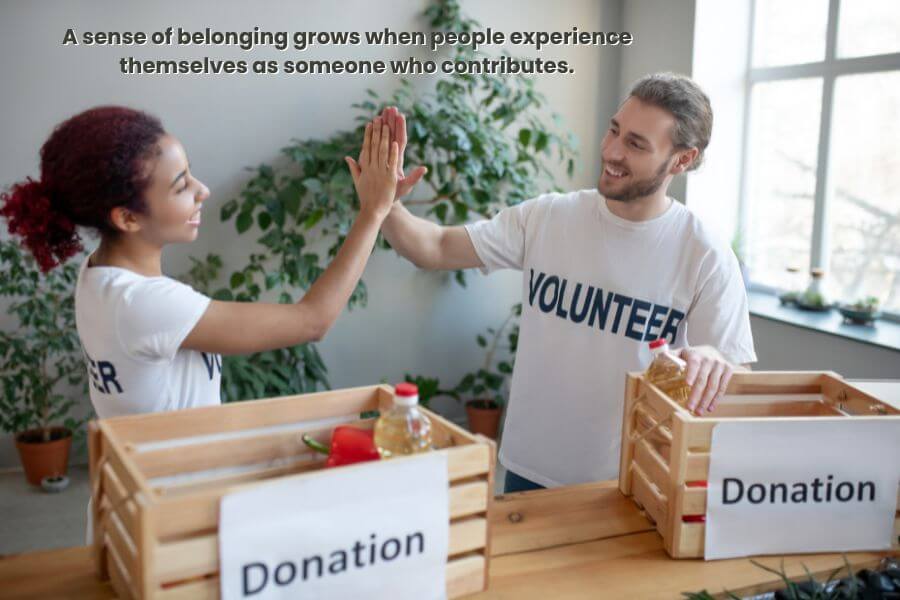
A sense of belonging grows when people experience themselves as someone who contributes. Research on motivation and connection shows that having a role — even a modest one — supports agency and value. This makes it easier to feel a sense of belonging, because you’re not only included, you matter. You’re part of the puzzle.
How to do this in everyday life
Look for small, realistic roles, not big responsibilities (unless that’s your jam of course). Examples:
- being the person who checks in on one neighbour or colleague
- bringing a familiar dish or idea into a shared space
- helping with one recurring task others rely on
- sharing a skill, language, or perspective that’s part of you
These don’t need to be formal. What matters is consistency and sincerity.
Especially when you choose something that is part of you, it’s more likely you’ll connect to people with shared values or interests. That might just be the thing you need in an entirely new place.
5. Let Yourself Be Seen in Low-Risk Ways
A sense of belonging often grows through moments of visibility (not necessarily big personal disclosures) and acceptance. Feeling seen and heard. Easier said than done maybe, but so, so powerful!

Why this helps
People tend to feel a sense of belonging when parts of who they are are noticed and received without judgment. Being seen in low-risk ways helps build trust gradually and supports a belonging sense that feels safe.
My favorite places to do this are authentic relating circles, or some place where people are more likely to have practiced concepts like non-violent communication or radical honesty. Or continuing a hobby or starting a new one, and practicing sharing with people who have these interests in common. Whatever works for you!
How to do this without overdoing it
Start with small, everyday expressions of yourself. Something that doesn’t feel too exposed or vulnerable right off the bat. For example:
- sharing a preference (“I actually love these types of movies”)
- mentioning a familiar habit or routine
- bringing a cultural or personal detail into conversation
- expressing a simple opinion without explaining it away (a difficult one for us recovering people-pleasers with rejection-sensitivity!)
These moments simply allow others to meet you where you are.
If you’re trying to create a sense of belonging, aim for consistency instead of intensity. Repeated, low-risk visibility helps a sense of belonging form naturally, without pressure to be fully known all at once.
But again, we all move at our own pace. Respect yours, and be kind to yourself.
If this topic of belonging resonates and you want to explore this more deeply, these books are thoughtful companions:

Great Books about Belonging
Belonging Beyond Borders (Amazon)
A practical, compassionate guide written specifically for adult Third Culture Kids, focused on cultivating belonging beyond place or nationality.
Belonging Everywhere and Nowhere (Amazon) or get on Bookshop.org
Absolute must-read for counselors or anyone coaching adult third culture kids.
6. Create Shared Meaning Through Story and Memory
A sense of belonging often strengthens when people can place themselves inside a shared story, rather than feeling like outsiders to it.
Why this helps
Belonging is closely linked to meaning-making. Research in psychology shows that people feel a sense of belonging more easily when their experiences are recognised as part of a larger narrative. Without this, memories can feel fragmented, which weakens a belonging sense over time.
Shared stories help connect past, present, and future. They don’t erase loss or change, but they give experiences a place to “land”. Which then makes it easier to create a sense of belonging even when circumstances feel complicated.
How to work with this in real life
Don’t overthink it, you have been living your story! Simple practices are enough, such as:
- naming shared moments (“Remember when we first arrived here?”)
- acknowledging meaningful transitions or endings
- keeping traditions that carry memories forward
- reflecting together on what has shaped you
These sense of belonging examples help people feel seen — not just socially, but emotionally.
When experiences are named and remembered, belonging becomes something that can grow through feeling seen and heard.
And who doesn’t love a good story?
7. Build a Sense of Belonging by Returning to Your Center
For many people, the deepest sense of belonging doesn’t come from a place or a group, but from feeling truly at home inside themselves.

Why this helps
When life has largely been shaped by constant adapting or moving, people often lose their internal reference point. Belonging then becomes something to search for externally.
But research and practice in embodiment, martial arts, and psychology all point to the same thing: people feel a sense of belonging most reliably when they are connected to something bigger than themselves.
In Eastern martial arts traditions, this is described as returning to the center — often called the hara or lower dantian — where we connect to ourselves and the energies of the earth and cosmos. From this energetic center in ourselves, we can find our inner balance and strength. It’s crucial to a sense of home in our bodies.
Mark Walsh’s (Embodiment Unlimited) work on finding purpose and his tetrarchy model highlight how connection to something larger is woven through healthy regulation – whether it be through religion or whatever spirituality practices float your boat. Without that foundational layer, belonging often stays fragile and dependent on external circumstances outside of our control.
This is also what spiritual teachers point to when they describe alignment with one’s inner being or inner self (there are many names used for this concept): we can feel true belonging when we are connected to this source.
It might sound too “woo” for some people, but it’s truly life changing once you learn to connect to this feeling.
What this looks like in practice
This is not necessarily about belief. Try it out and experience it for yourself.
Practices drawn from martial arts, meditation, embodiment coaching, and programs like Jongens in hun Kracht deliberately slow people down and bring awareness into the body.
When the mind becomes calm, people often notice:
- deeper belly breaths
- more awareness of posture
- a clearer sense of “I am here” (hard to put in words, but when you know you know)
That physical presence and awareness supports a belonging feeling that doesn’t depend on external validation or any other external circumstances. You’re in control. How cool is that?
Simple ways to work with this
Some of my favorite practices (outside the dojo, but if you have one available I highly recommend using the space to feel your body on the mats and SLOW down!):
- pause and feel your feet connecting with the ground (set reminders at least 5x per day)
- bring attention to the lower belly while breathing
- meditation 15-20 minutes every morning (focus on your breathing, “this one’s in, this one’s out”)
- spend a few minutes fully present in one physical action, for example a mindful walk or having a meal
These practices help create a sense of belonging by reconnecting you to yourself and, to something larger than your individual story.
When people ask, “Why don’t I feel at home anywhere?”, the answer is often not actually about a location, but how connected they feel to themselves in the moment. I hope you try it, and please let me know your experience in the comments!
(If you’d like coaching on this you can of course reach out to me).
8. Notice How Your Environment Interacts With Your Sense of Self
The places you spend time in don’t automatically give you a sense of belonging. Belonging often comes from the interaction between your experience, memories, social patterns, and environment.
Why this helps
Research on belonging and place attachment shows that environments become meaningful mostly through experience, interaction, and social context. People develop attachment to a place because it becomes part of their personal story and identity. This is influenced by activities, interactions, memories, and continuity over time.
For TCKs and globally mobile people, this can show up as:
- sometimes feeling “at home” in bustling cities vs quiet little towns
- feeling out of place when cultural or social norms are unfamiliar
- building belonging faster when there is a class nearby for your favorite hobby or sport
- finding belonging with a person or community who speak your home language(s)
Obviously, there are thousands of examples, but you know your story and experience best. Hopefully these ideas will help you explore how your story relates to your environment, which then helps to connect dots to grow that elusive sense of belonging.

How to work with this intentionally in real life
Rather than searching for the “right” place, try this approach:
1. Notice meaningful experiences where you’ve felt calm and “grounded” (like yourself, authentic, you know?).
Ask yourself:
- Where have I felt most myself in my body? (is there a similar location or vibe in the new environment?)
- Where did I feel recharged?
These are sense of belonging examples rooted in experience, so you can take those with you to different places!
2. Let memory help create safe environments.
Places where positive experiences happened — even briefly — can be used again (coffee shop, park bench, classroom corner).
3. See the environment as interaction, not just the backdrop for your life.
Belonging grows when things align with your identity. Think of your environment, the activities you do, the people you are with, availability of your favorite food, and so on!
For globally mobile lives, this often means you have to create environments where these aspects match your internal sense of home.
Instead of thinking, “This place should feel like home,” try: “Where have I already built meaning here, and how can I bring more of that into my day?”
This makes belonging something we can work toward with practical steps.
9. Allow Belonging to Be Built Gradually
A sense of belonging rarely appears all at once. It usually grows through repeated, ordinary moments.
Why this helps
One of the most painful beliefs around belonging is the idea that it should already be there, and if it isn’t, something is wrong. In reality, most people feel a sense of belonging only after lived experiences have accumulated. It takes time to get familiar with people and places, give yourself time and be kind to yourself!
For people frequently going through transitions, this process starts over on a regular basis. That doesn’t mean belonging is impossible. It means it needs time to build again. Letting it build gradually reduces pressure and makes a belonging feeling more sustainable.
And! Let’s not forget the fast-growing number of TCKS (third culture kids). This might be a group you belong to, and even though they’re not all in the same place as a traditional community, it’s a community nonetheless!
If you want to know more about third culture kids and how to support them or yourself, definitely check out this post:
How to support this without forcing it
You can create a sense of belonging by:
- appreciating what’s “good enough” instead of waiting for perfect (more will come once you start to focus on things to appreciate. Try it!)
- noticing signs of familiarity or ease (write them down and look at the list when you need to feel hopeful again)
- allowing yourself to belong partially before fully (it’s a process, and you’ll get there)
Frequently Asked Questions About a Sense of Belonging
Throughout my studies and work in international schools, some of the most common questions I heard are from people trying to understand why belonging feels complicated, and what might help. Let’s get into it.
What is a sense of belonging, really?
A sense of belonging is the felt experience of being connected and feeling like a part of something. Not just socially, but internally. It’s about feeling safe enough to be yourself and to exist without constantly adapting or explaining who you are. Belonging is not about fitting in (that’s not authentic), and more about feeling at ease in your own presence and with others. Authentically.
Why is it so hard to feel a sense of belonging when you’ve lived in multiple countries?
For globally mobile people, a sense of belonging is often disrupted by repeated transitions. Each move basically resets relationships and reference points. Research on relocation and identity shows that this can create a pattern of emotional vigilance: you stay open, but guarded. This is especially common among stayers.
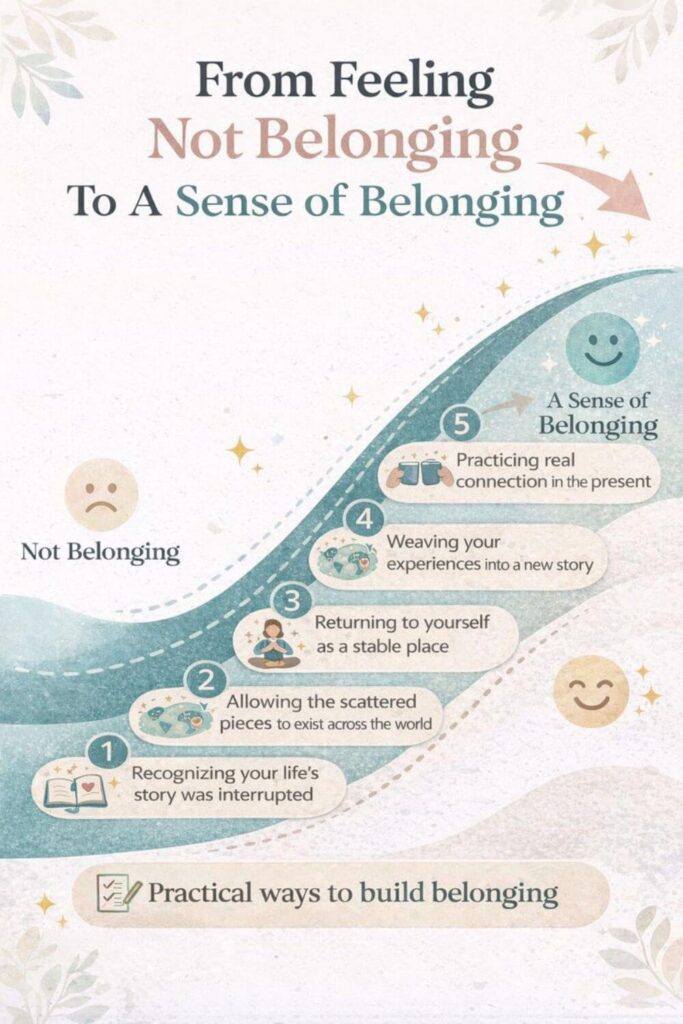
It’s quite logical, though, the idea of belonging being more elusive when you move a lot. If you consider that we all live our own stories, and that people, places, etc., are all part of that, then that means relocation causes pieces of our story to be spread out across the world. Our story doesn’t seem to be whole anymore. So, questions around “Where do I belong?” logically follow.
In this case, I hope you find way 7 in this post to be particularly helpful (along with the other more practical ones). I wish for all of us to feel like we belong, and I wish this post will help you get there.
Why do I feel like I belong everywhere and nowhere at the same time?
This is a very common experience among internationally mobile people. You may recognise yourself in many cultures and places, yet feel fully anchored in none. A sense of belonging doesn’t usually come from location alone; it often comes from meaning, relationships, and how connected you feel to yourself in the present moment. When those anchors keep changing, belonging can feel abstract.
Is it possible to create a sense of belonging on your own?
You can create a sense of belonging internally, but not in isolation from the world. Practices that reconnect you to your body, your values, and something larger than yourself help you feel more at home within. That internal “connectedness” (is that a word?) makes external belonging something that feels more accessible.
I do believe that without that connection to our true selves (inner self, center, source, there are lots of names for this concept), we cannot find true belonging anywhere. So it’s absolutely a great place to start, and from there, it’s so much easier to connect to others and build that sense of belonging outside of yourself as well.
How long does it take to build a sense of belonging?
There is no single timeline, but research on relocation, attachment, and social integration suggests that early signs of belonging often appear within weeks to a few months, while a deeper sense of belonging usually takes longer — often many months or more — especially after repeated moves.
However, as we discussed in way 7, creating a sense of home within ourselves is the most foundational way of building a sense of belongingness. Depending on how much you’ve practiced that, that feeling can come quite easily. And from there on, belonging can be much easier. So don’t let anyone tell you what you can and can’t accomplish.
What if I’m doing all the “right things” and still don’t feel a sense of belonging?
That’s very common. Let me first say this: It doesn’t mean you’re failing. A sense of belonging isn’t something you achieve through effort alone. It emerges when conditions are right. If belonging still feels out of reach, it may simply mean your system needs more safety, time, or support. Belonging responds to patience far more than when you try to force it. You’ll get there.